When your three-year-old shares their toy with a crying classmate or your preschooler takes deep breaths to calm down after a disappointment, you’re witnessing social emotional learning in action. These aren’t just sweet moments—they’re critical building blocks for your child’s lifelong mental health, academic success, and relationships.
Social emotional learning, or SEL, teaches young children five essential skills: recognizing and managing their feelings, setting positive goals, showing empathy for others, building healthy relationships, and making responsible choices. While these might sound like complex abilities for someone who still needs help tying their shoes, research shows that ages 3-5 are actually the ideal window for developing these competencies. During these years, children’s brains are remarkably receptive to learning how emotions work and how to navigate social situations.
The benefits extend far beyond the preschool years. Children who receive quality SEL instruction show better behavior, stronger friendships, improved focus, and higher academic achievement throughout their school careers. They’re also more resilient when facing challenges and less likely to experience anxiety or behavioral problems.
Whether you’re a parent choosing a childcare program, an educator designing your curriculum, or a healthcare professional supporting families, understanding how SEL works in early childhood settings empowers you to give young children the emotional foundation they need to thrive. This guide will show you exactly what effective preschool SEL looks like and how to support it.
What Social Emotional Learning Really Means for Young Children
It’s More Than Just ‘Being Nice’
When you hear “social emotional learning,” you might picture children sitting quietly and saying “please” and “thank you.” While politeness is wonderful, SEL goes much deeper than surface-level manners.
Think of it this way: teaching a child to say “I’m sorry” is about behavior, but helping preschoolers manage emotions teaches them to actually understand why they’re apologizing and how their actions affected someone else. That’s the SEL difference.
Dr. Rebecca Martinez, a child psychologist with 15 years of experience, explains: “SEL isn’t about creating perfectly behaved children. It’s about giving them the tools to understand themselves and others, which naturally leads to more positive interactions.”
Unlike traditional discipline that focuses on compliance, SEL nurtures skills like self-awareness, empathy, and problem-solving. A child who learns SEL doesn’t just follow rules because they’re told to. They develop the capacity to recognize their feelings, consider others’ perspectives, and make thoughtful choices, even when no adult is watching. These are foundational life skills that extend far beyond the preschool years, shaping how children navigate relationships, handle challenges, and view themselves throughout their lives.
Why These Years Matter So Much
Between ages three and six, your child’s brain is undergoing remarkable changes that create a unique window of opportunity for early childhood development. During this period, the brain forms more than one million neural connections every second, building the foundational architecture for all future learning, behavior, and health.
This isn’t just about academics. The preschool years are when children develop the capacity to recognize and manage emotions, build relationships, and navigate social situations. These skills don’t emerge automatically—they’re learned through experience and supportive interactions with caring adults.
Dr. Sarah Martinez, a developmental pediatrician with 20 years of experience, explains: “Think of these early years as building the foundation of a house. The emotional and social skills children develop now become the structure that supports everything else they’ll learn throughout their lives. We can certainly add to that foundation later, but it’s much easier to build it right from the start.”
Research shows that children who develop strong social-emotional skills during preschool are better equipped to handle stress, form healthy relationships, and succeed academically. They’re also more likely to experience better mental health outcomes as they grow.
The developmental milestones happening during this time make it especially powerful for learning. Three to six-year-olds are naturally developing empathy, beginning to understand different perspectives, and learning to regulate their emotions. When we intentionally support these emerging abilities through social emotional learning, we’re working with their natural development rather than against it.
This doesn’t mean missing this window closes the door forever, but investing in these skills now gives children tremendous advantages that ripple throughout their entire lives.
What SEL Looks Like in Your Child’s Day
In the Classroom
Walk into any quality preschool classroom, and you’ll likely witness social emotional learning in action, woven seamlessly into the daily routine. These aren’t complicated programs requiring special equipment—they’re thoughtful practices that help young children understand themselves and others.
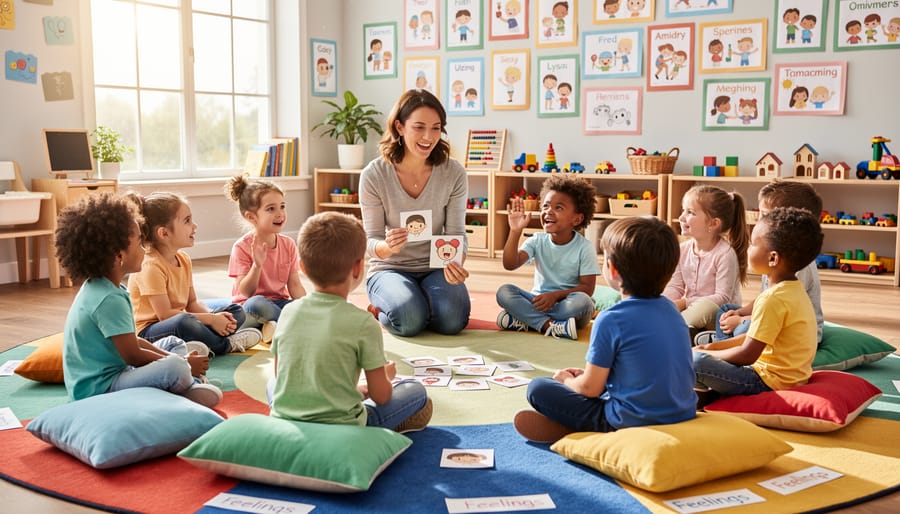
Circle time serves as an emotional anchor for many classrooms. Teachers might pass around a feelings chart, inviting each child to share how they’re feeling that day. “I’m using my red card because my dog is sick,” four-year-old Marcus might say, learning to name and express his worry in a safe space.
Emotion check-ins throughout the day help children pause and recognize what’s happening inside. A teacher might ask, “I notice your fists are tight. What’s your body telling you?” This simple question teaches children to connect physical sensations with emotions—a skill that serves them for life.
Conflict resolution corners, sometimes called peace tables or calm-down spaces, give children tools to work through disagreements. Rather than immediately intervening, teachers guide children to talk through problems using prompts like “Tell your friend how that made you feel” or “What could we do differently next time?”
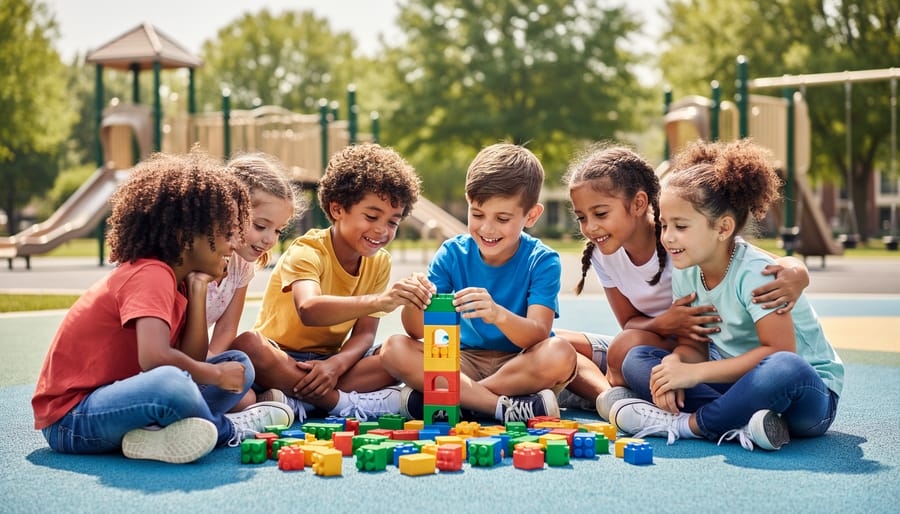
Cooperative play activities—building a block tower together, creating a group art project, or playing pretend grocery store—naturally develop empathy and teamwork. As one veteran preschool teacher shared, “When children work together toward a common goal, they learn that everyone’s contribution matters. That’s a powerful lesson at any age.”
These practices create classrooms where children feel seen, heard, and emotionally safe—the foundation for all learning.
During Transitions and Challenging Moments
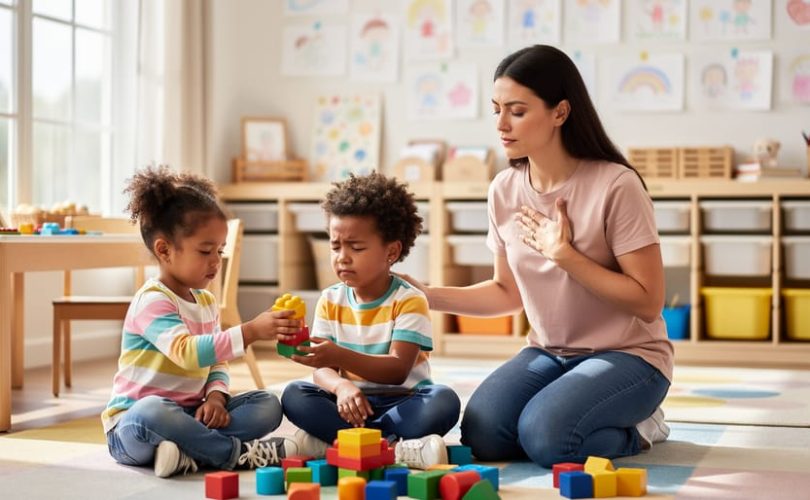
The most powerful social-emotional learning often happens when children face everyday challenges. Quality preschool and childcare programs recognize that moments of struggle—when two children want the same toy, when a parent walks out the door, or when someone feels left out—are golden opportunities for growth.
Rather than rushing to fix these situations, skilled educators guide children through them. When Maya grabbed a truck from Jamal, their teacher didn’t immediately intervene. Instead, she knelt beside them and asked, “I see you both want the red truck. How does that feel?” This simple question helped both children identify their emotions and begin problem-solving together.
Dr. Rebecca Chen, an early childhood specialist, explains: “We used to think our job was preventing distress. Now we understand that learning to navigate difficult feelings, with support, builds resilience.” This approach transforms tough moments into learning experiences.
Goodbye tears at drop-off offer another teaching opportunity. Teachers who acknowledge these feelings—”It’s hard when Daddy leaves. Your sad feelings are okay”—help children understand that all emotions are valid. They might create a goodbye ritual or point to a visual schedule showing when parents return, building trust and emotional security.
The key difference in quality programs is intentionality. Educators don’t just manage behavior; they ask reflective questions, model problem-solving, and give children language for their experiences. One parent shared: “My son used to hit when frustrated. His teacher taught him to say ‘I need space’ instead. Now he uses those words at home too.”
The Real Benefits You’ll See in Your Child
Better Friendships and Less Drama
When preschoolers learn to recognize and manage their emotions, something wonderful happens: they fight less and connect more. SEL gives young children the tools to express frustration with words instead of grabbing toys or pushing. They learn to take turns, share space, and understand that their friend might feel sad or excited too.
Dr. Rachel Morris, a child psychologist, explains: “Children who practice emotional skills have fewer meltdowns and recover faster when conflicts do happen. They’re building social skills that protect them from isolation and help them form genuine connections.”
Maria, a preschool teacher for twelve years, noticed the change in her classroom: “After introducing SEL activities, we went from multiple biting incidents weekly to maybe one every few months. The children started using their words and asking teachers for help solving problems.”
These early friendship skills matter tremendously. Children who navigate social situations successfully feel more confident and secure. They learn that disagreements don’t mean the end of friendships and that they have the power to repair relationships through apologies and kindness.
Confidence That Lasts Into Elementary School
The social-emotional skills children develop during their preschool years create a foundation that extends far beyond early childhood. Research consistently shows that children who receive quality social-emotional learning are better prepared for kindergarten and demonstrate stronger academic performance in elementary school. They enter formal schooling already equipped with the ability to follow directions, work cooperatively with peers, and persist through challenges—all critical ingredients for learning success.
Dr. Maria Chen, an early childhood development specialist, shares her observations: “I’ve watched countless children transition from our SEL-focused preschool into kindergarten. The difference is remarkable. These kids adapt more easily to new routines, form friendships more quickly, and approach new material with curiosity rather than anxiety.”
Beyond academics, the emotional resilience built through early SEL helps children navigate the inevitable ups and downs of elementary school. When a child faces disappointment over a lost game or struggles with a difficult math concept, those early lessons in identifying feelings and problem-solving become invaluable tools. They’re less likely to give up immediately or react with frustration, and more likely to ask for help or try alternative approaches.
One parent, Jessica, noticed the long-term impact firsthand: “My daughter learned conflict resolution strategies in her childcare center at age four. Now in second grade, I still hear her using those same calming techniques when she’s upset. She’ll take deep breaths and use her words to explain what’s bothering her—skills that will serve her throughout life.”
This early investment in emotional development pays dividends for years to come.
How to Spot a Program That Actually Does SEL Well
When you’re touring preschools or childcare centers, knowing what to look for can make all the difference. A strong SEL program isn’t just about posters on the wall—it’s woven into everyday interactions and routines.
Start by observing how teachers respond to big emotions. Do they kneel down to a child’s level during a meltdown, offering comfort and words that name the feeling? Or do they rush to distract or dismiss? Green flag programs treat emotional moments as learning opportunities, not disruptions.
Ask about their approach to conflict resolution. Quality programs teach children problem-solving skills rather than simply separating kids or imposing adult solutions. You might hear teachers say things like, “I see you both want the red truck. What can we do to solve this together?”
Look for intentional emotion vocabulary throughout the day. Teachers should regularly use words like frustrated, disappointed, proud, and excited—not just happy, sad, or mad. This shows they’re building emotional literacy as a core skill.
Check if the program has structured time for relationship-building activities like morning circles, partner work, or collaborative projects. SEL thrives when children practice cooperation regularly, not just during planned lessons.
Red flags include rigid behavior charts that shame children publicly, frequent time-outs without teaching moments, or staff who seem overwhelmed and reactive rather than calm and responsive. If teachers can’t articulate how they support emotional development or seem dismissive when you ask, that’s concerning.
Don’t hesitate to ask about teacher training in child development and SEL specifically. Well-prepared educators understand age-appropriate expectations and have strategies ready.
Remember, strong SEL programs welcome questions and partner with families using parental involvement strategies that extend learning beyond the classroom. Your instincts matter—if a program feels warm, responsive, and genuinely focused on the whole child, you’re likely on the right track.
Supporting SEL at Home
Simple Daily Practices That Make a Difference
You don’t need a fancy curriculum to support social-emotional growth in young children. Small, intentional moments throughout the day can make a remarkable impact.
Start by naming emotions as they happen. When a child’s face crumples before tears fall, you might say, “You look frustrated that the tower fell down.” This simple practice builds emotional vocabulary and helps children recognize what they’re feeling. Over time, they learn to express themselves with words instead of meltdowns.
Your behavior is their blueprint. Children watch everything you do. When you take a deep breath after spilling coffee or apologize when you snap, they’re learning powerful skills. One teacher shared how her students started saying “I need a break” after watching her step away when overwhelmed—proof that modeling works.
Create judgment-free zones for all feelings. Let children know that feeling angry, sad, or scared is okay, even when certain behaviors aren’t. You might say, “It’s okay to feel mad, but we don’t hit. Let’s find another way to show those big feelings.”
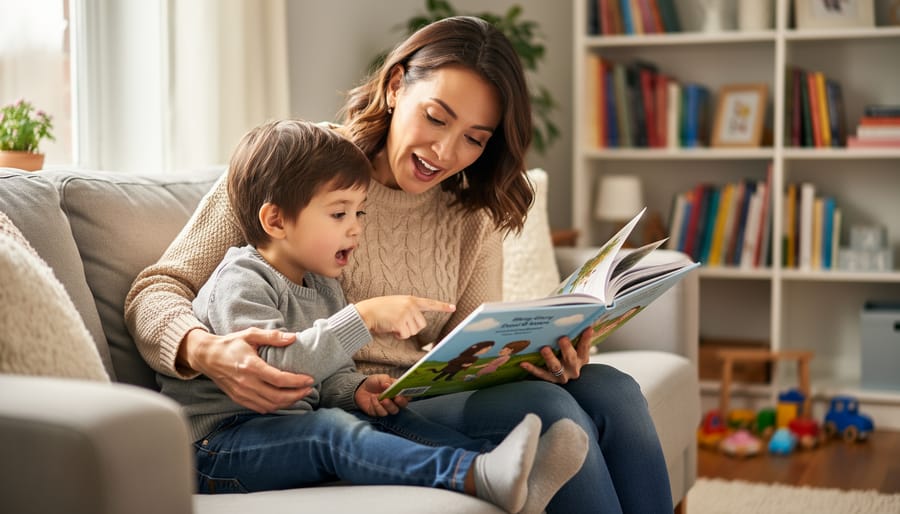
Books and play are natural SEL teachers. Stories let children explore emotions safely, while pretend play builds empathy as they step into different roles. A toy kitchen becomes a laboratory for cooperation; puppets become therapists for working through conflicts.
These practices work hand-in-hand with teaching healthy choices, creating children who understand both their feelings and their actions.
When Your Child Struggles
If your child has frequent meltdowns, struggles to share, or seems overwhelmed by their emotions, you’re not alone. Many preschoolers find emotional regulation challenging—it’s actually a normal part of development. Dr. Sarah Mitchell, a child psychologist, reminds us that “learning to manage big feelings is like learning to walk. There will be stumbles along the way.”
Watch for patterns rather than isolated incidents. Does your child have difficulty calming down after more than 20-30 minutes? Do they frequently hurt themselves or others? Are daily activities like drop-off consistently traumatic? These signs may warrant a conversation with your pediatrician.
Maria, mother of four-year-old James, shares: “I felt like I was failing when James struggled while other kids seemed fine. Talking to his teacher helped me see he just needed extra support, not that something was wrong with him.”
Remember, asking for help is a strength, not a weakness. Early intervention specialists, play therapists, and developmental pediatricians can provide strategies tailored to your child’s needs. Some children simply need more time and support to develop these skills—and that’s perfectly okay.
As you consider your child’s early learning journey, remember that choosing a program with strong social-emotional learning isn’t about being a perfect parent—it’s about giving your child tools that will serve them for life. SEL doesn’t require special equipment or expensive resources; it thrives in environments where educators genuinely care about the whole child.
Maria, a mother of two, shares her experience: “When we enrolled our daughter at preschool Moorebank, I wasn’t even sure what SEL meant. Within months, I watched my shy three-year-old transform. She started using words to express frustration instead of tantrums, and she began asking classmates how they felt. These weren’t things I directly taught her—they came from daily practice in a supportive environment. Now my son is there too, and I see the same beautiful growth.”
You don’t need to feel anxious about whether your child’s program measures up perfectly. What matters is that caregivers prioritize emotional safety, model healthy relationships, and create opportunities for children to practice important skills like sharing, problem-solving, and self-regulation.
If your current childcare setting doesn’t emphasize SEL, advocate for it. Share what you’ve learned with teachers and directors. Many educators welcome parent input and may simply need resources or encouragement to strengthen these practices. Your voice matters in creating nurturing spaces where all children can develop both their minds and hearts.