
Teach your child to practice box breathing when anxiety strikes: breathe in for four counts, hold for four, exhale for four, hold for four, and repeat. This simple technique activates the parasympathetic nervous system within minutes, giving kids something concrete to do when their world feels out of control.
Ground them with the 5-4-3-2-1 method. Ask your child to name five things they can see, four they can touch, three they can hear, two they can smell, and one they can taste. This sensory exercise pulls them out of anxious thoughts and anchors them in the present moment.
Create a worry time window, typically 15 minutes at the same time daily, where your child can express every concern without interruption. Outside this window, gently redirect worries to the designated time. Research shows this containment strategy prevents anxiety from consuming the entire day.
Validate feelings without fixing them immediately. When your child says they’re stressed about school, resist jumping to solutions. Instead, try: “That sounds really hard. Tell me more about what’s making you feel this way.” Dr. Sarah Mitchell, a child psychologist with 20 years of experience, notes that kids who feel heard often self-regulate more effectively than those given immediate solutions.
You’re reading this because someone you love is struggling, and that concern shows you’re already doing something right. The difference between helping and enabling comes down to teaching skills versus removing all discomfort. Your child needs to learn they can handle difficult feelings, not that feelings should be avoided entirely.
Most coping mechanisms fail because they’re introduced during crisis moments rather than practiced during calm times. Think of anxiety tools like fire drills. You wouldn’t wait for a real fire to teach the escape route. Start practicing these techniques when your child feels settled, making them second nature before stress hits.
The strategies that work best combine immediate relief with long-term skill building, addressing both the urgent need and the underlying patterns.
Why Traditional ‘Calm Down’ Advice Doesn’t Work
When your child is spiraling into anxiety and you say “just calm down” or “there’s nothing to worry about,” you’re not helping, you’re actually making things worse. I know that’s hard to hear, especially when you’re saying it from a place of love and genuine desire to help. But here’s what’s happening in that moment: your child’s brain has triggered a very real alarm system, flooding their body with stress hormones. Their heart is racing, their stomach is churning, and their thoughts are spinning. Telling them to simply stop this biological response is like telling someone with a broken leg to just walk it off.
The developing brain processes anxiety differently than an adult brain does. The prefrontal cortex, which handles rational thinking and emotional regulation, isn’t fully developed until the mid-twenties. When anxiety hits, children literally cannot access the same logical reasoning adults use to talk themselves down. They’re operating from their amygdala, the brain’s alarm center, which doesn’t respond to logic or vague commands to relax. It needs concrete, physical actions to signal safety.
This explains why a stressed eight-year-old can’t follow instructions like “think positive thoughts” or “don’t stress about it.” These phrases are too abstract. They don’t give the child’s body anything to do with the adrenaline coursing through it, and they don’t provide the brain with a specific alternative to focus on. Worse, they often communicate to the child that their very real distress is invalid or something they should be able to control but are failing at.
Your child needs tools, not lectures. They need someone to show them how to blow bubbles slowly, or squeeze their fists tight then release them, or name five things they can see. These concrete actions give their nervous system something to work with.
Understanding Your Child’s Anxiety Response
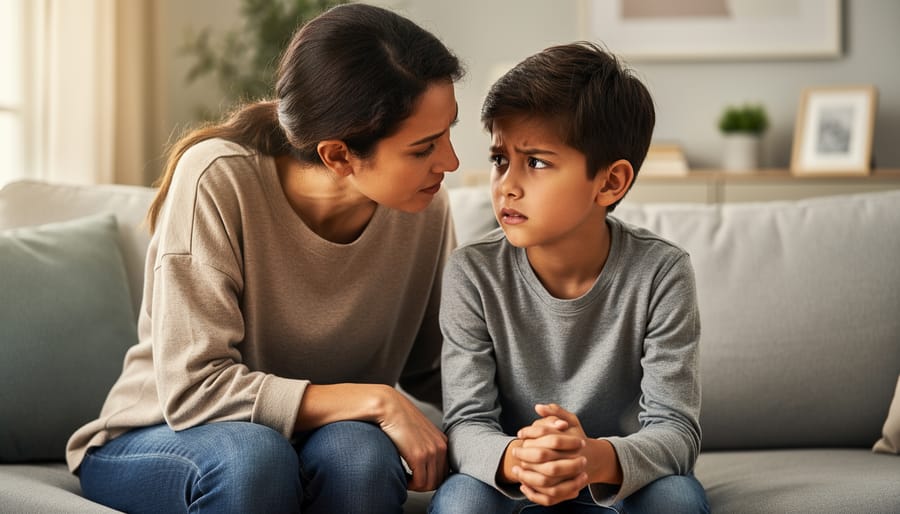
Children show anxiety in kids very differently than adults do, which often confuses parents trying to figure out what’s actually happening. While adults might pace and worry out loud, children’s anxiety frequently hides behind symptoms that look completely unrelated to mental health.
The physical signs often appear first and can be surprisingly intense. Your child might complain of stomachaches every school morning, develop headaches before tests, or say their heart is beating too fast. These aren’t made-up complaints. physical anxiety symptoms are real responses to perceived threat, triggered by the same fight-or-flight system that kept our ancestors safe. In children, this can also show up as dizziness, nausea, shaking hands, or the sudden urgent need to use the bathroom. Young children especially struggle to connect these body sensations to feelings of worry.
Emotionally, anxious children rarely announce “I feel anxious.” Instead, you might see irritability that seems disproportionate to the situation, sudden clinginess from a previously independent child, or withdrawal from activities they used to enjoy. Some children become unusually quiet and compliant, trying to be perfect to avoid triggering whatever they fear. Others become explosive over minor changes to routine. These emotional shifts aren’t manipulation, they’re how a child’s developing brain manages overwhelming feelings it doesn’t yet have words for.
The behavioral signs often perplex parents the most. Avoidance is anxiety’s signature move: refusing to go to birthday parties, melting down before sports practice, or suddenly “forgetting” homework rather than turning in something imperfect. You might notice perfectionism that leads to erasing papers until they tear, or procrastination that stems from fear of failure rather than laziness. Meltdowns that seem to come from nowhere often build from accumulated anxiety that finally exceeds the child’s capacity to contain it.
What ties all these manifestations together is that they’re genuine distress signals, not attention-seeking behavior. Your child isn’t choosing to feel this way or trying to get out of responsibilities. Their nervous system genuinely perceives threat, whether or not adults see the danger. Recognizing this distinction helps you respond with compassion rather than frustration, which is the first step toward helping them develop effective coping strategies.
Immediate Coping Techniques for Anxious Moments

Breathing and Body-Based Techniques
The most effective proven anxiety strategies start with helping children reconnect with their bodies. When anxiety hijacks the nervous system, simple breathing exercises can hit the reset button. The key is teaching these mind-body techniques during calm moments, not in the middle of a meltdown.
Bubble breathing works beautifully for younger children. Have your child pretend they’re blowing bubbles, taking a slow breath in through the nose and then exhaling gently through pursed lips. The slower they blow, the bigger the imaginary bubble. For school-age kids, the smell-the-flower-blow-out-the-candle technique makes sense immediately: breathe in deeply through your nose like you’re smelling a flower, then exhale through your mouth as if blowing out birthday candles.
The 5-4-3-2-1 grounding technique pulls anxious minds back to the present moment by engaging the senses:
- Name 5 things you can see around you right now
- Identify 4 things you can physically touch or feel
- Notice 3 sounds you can hear in this moment
- Recognize 2 things you can smell, or 2 smells you like
- Name 1 thing you can taste, or 1 thing you’re grateful for
Walk through this exercise together several times when your child feels calm. They’ll absorb it better and actually remember it when anxiety strikes.
Progressive muscle relaxation simplifies nicely for kids by turning it into a game. Start at the toes and work up: squeeze your toes tight like you’re making a fist with your feet, hold for three seconds, then let them go floppy. Move to the legs, tummy, hands, arms, shoulders, and face. Many children love the turtle technique, pulling everything tight into their shell, then slowly relaxing back out.
Practice these techniques for just two minutes during bedtime or car rides. Repetition builds muscle memory, so when anxiety shows up uninvited, your child has tools within reach.
Thought-Based Coping Strategies
Children’s minds are constantly churning with thoughts, and when anxiety takes hold, those thoughts spiral quickly. Teaching kids to work with their thinking patterns gives them real power over their worry.
**Scheduling Worry Time**
This technique sounds counterintuitive, but it works remarkably well. Designate a specific 10-15 minute “worry window” each day when your child can voice every concern. Outside that time, when worries pop up, remind them to save it for worry time. You’re not dismissing their feelings; you’re teaching their brain that worries don’t need immediate attention. Many children find that by the scheduled time, half their worries have already faded.
**Externalizing the Anxiety**
Younger children especially benefit from giving their anxiety a name or visual form. “Is the Worry Monster visiting again?” transforms an overwhelming internal experience into something manageable and separate from themselves. Some kids draw their anxiety, which helps them literally see it shrink as they gain control. One seven-year-old I know named her anxiety “Larry” and would tell him firmly, “Larry, you’re not the boss of me today.”
**Reality-Testing Worried Thoughts**
Older children can learn to question their anxious predictions. When your daughter says, “Everyone will laugh at my presentation,” guide her through evidence gathering: “Has that happened before? What actually happened last time? What would you tell a friend who said that?” Don’t dismiss the fear, but help her see the difference between possible and probable.
**Building Positive Self-Talk**
Replace “I can’t do this” with “This is hard, but I can try.” The shift from absolute statements to process-oriented ones matters tremendously. Practice together when stakes are low, so the skill’s available when anxiety strikes.

Physical Movement and Sensory Tools
When anxiety spikes, the body floods with stress hormones that demand physical release. Movement isn’t just a distraction, it literally helps metabolize adrenaline and cortisol, resetting the nervous system to a calmer state. For many children, especially those who struggle with sitting still or verbal processing, physical and sensory strategies work faster than talk-based techniques.
Start with simple, vigorous movements that require no equipment. Jumping jacks, running in place, or doing wall pushes (pushing against a wall with full body weight for 10-15 seconds) give anxious energy somewhere to go. A quick walk around the block or spontaneous dance session to a favorite song can shift mood remarkably fast. The key is matching the intensity to what the child needs, sometimes slow, deliberate stretching works better than high energy.
Sensory tools provide another pathway to calm. Stress balls, fidgets, or therapy putty give hands something productive to do during worry spirals. Weighted blankets or lap pads offer gentle pressure that many children find soothing. Cold water, splashing it on the face, holding an ice cube, or drinking it slowly, activates the vagus nerve and can interrupt panic responses.
What calms one child might agitate another. Some kids need movement; others need stillness. Some respond to squeezing something; others prefer smooth, repetitive textures. Watch what your child naturally gravitates toward during calm moments, then build on those preferences when anxiety strikes. The most effective tool is whichever one your child will actually use.

Building Long-Term Resilience Against Anxiety
Creating Predictable Routines and Safe Spaces
When a child’s day feels unpredictable, their nervous system stays on high alert, scanning for potential threats. Routines lower this baseline vigilance, freeing mental energy for learning, playing, and simply being a kid rather than constantly bracing for what comes next.
Start with bookend routines at the beginning and end of each day. A consistent morning sequence (wake, breakfast, dress, teeth, shoes, goodbye hug) creates a reliable launch pad. An evening routine (bath, pajamas, story, lights out at roughly the same time) signals safety and wind-down. These don’t need to be rigid schedules down to the minute, but the order and general timing matter. When children know what’s coming, their bodies can relax.
Transition warnings are small kindnesses for anxious minds. A five-minute heads-up before leaving the park, a reminder the night before about tomorrow’s dentist appointment, or a quick preview of the day’s schedule over breakfast helps children mentally prepare. Surprises and sudden shifts spike anxiety, while predictability builds trust that the world is manageable.
Physical safe spaces matter too. Whether it’s a cozy reading corner, a tent made of blankets, or simply their bed with favorite stuffed animals, children need a spot that feels reliably theirs when overwhelm hits. Some families create a “calm-down kit” (headphones, fidget toys, drawing supplies) in this space.
The balance comes in holding structure while allowing flexibility when it truly matters. Skip the bath one night if your child is melting down, but keep the story and cuddles. Consistency builds security; rigidity breeds more anxiety.
Gradual Exposure and Building Confidence
When a child avoids something that triggers anxiety, it brings immediate relief. The problem is, that relief teaches the brain the fear was justified. Each avoided playground, skipped party, or refused new food strengthens anxiety’s grip. The child learns they can’t handle difficult feelings, and the anxiety grows stronger.
Gradual exposure works differently. It teaches children they can tolerate discomfort and that feared outcomes rarely happen. The key is breaking overwhelming fears into steps so small they feel manageable, with you there as their steady support.
Start by identifying what your child avoids, then create a ladder of steps from easiest to hardest. If your child fears dogs, step one might be looking at dog pictures together. Step two could be watching dogs from across the park. Step three might be standing near a calm, small dog on a leash. Each step gets practiced until it feels boring, not scary, before moving forward.
Your role isn’t to push or lecture. It’s to stay calm, acknowledge their courage, and resist the urge to rescue them from manageable discomfort. Let them set the pace. Some children climb their ladder quickly; others need weeks on a single step. Both approaches work.
Celebrate every small victory genuinely. Not with over-the-top praise that feels fake, but with specific recognition: “You stayed at the birthday party for ten minutes today. Last week, you couldn’t walk through the door. That took real strength.” These moments build the evidence that anxiety lies, that they’re braver than they think, and that hard things become easier with practice.
How Parents Can Support Without Enabling
The hardest part of parenting an anxious child isn’t managing the anxiety itself. It’s navigating the razor-thin line between supporting your child and accidentally making things worse.
I learned this the hard way. For months, I let my daughter skip soccer practice whenever she felt nervous about it. I thought I was being compassionate, protecting her from distress. Instead, I was teaching her that anxiety was something to run from rather than work through. It took a conversation with her therapist to realize I needed to break the anxiety cycle I’d unknowingly created.
Supporting without enabling means validating feelings while not accommodating avoidance. When your child says they’re scared, the response isn’t “no you’re not” or “there’s nothing to worry about.” It’s “I hear that you’re feeling scared. That feeling is real, and we’re going to get through this together.” You acknowledge the emotion without letting it dictate all decisions.
| Situation | Helpful Support | Unhelpful Accommodation |
|---|---|---|
| Child anxious about school presentation | Practice together, discuss coping strategies, attend but let them present | Email teacher to excuse them or do presentation for them |
| Worried about trying new food | “You don’t have to like it, but let’s try one small bite together” | Make separate meal, never introduce new foods |
| Scared of sleeping alone | Gradual transition, comfort object, brief check-ins with increasing intervals | Parent sleeps in child’s room indefinitely |
| Anxious about playdate | Acknowledge nerves, discuss what might happen, stay nearby initially | Cancel all social activities, speak for child in interactions |
The shift happens when you move from solving problems for your child to solving them with your child. “What do you think might help you feel braver?” opens conversation. “Let me fix this for you” closes it.
Your own anxiety matters more than you realize. Children are remarkably attuned to parental stress. When you catastrophize about their struggles or hover anxiously, they absorb that tension. Model the coping mechanisms you want them to learn. Say out loud, “I’m feeling stressed about this deadline, so I’m going to take some deep breaths.” Let them see you handle uncertainty without falling apart.
This doesn’t mean suppressing genuine concern. It means managing it appropriately. Save the worried conversations with your partner for after bedtime, not in front of your child. Demonstrate confidence in their ability to cope, even when you’re not entirely sure yourself. Sometimes you’re teaching them and learning alongside them at the same time.
Professional Support and Current Resources
Sometimes the coping strategies you practice at home aren’t enough, and that’s completely okay. Recognizing when your child needs additional support is an act of parental wisdom, not an admission of failure. If anxiety is interfering with your child’s daily life, preventing school attendance, disrupting friendships, causing physical symptoms, or limiting their activities, it’s time to explore professional treatment options.
Several therapeutic approaches have proven particularly effective for childhood anxiety. Cognitive Behavioral Therapy (CBT) helps children identify anxious thoughts and replace them with more realistic ones while gradually facing their fears in a supportive environment. Play therapy works well for younger children who may struggle to verbalize their feelings, allowing them to process anxiety through natural play activities. Family therapy can be valuable when anxiety affects the whole household, helping everyone develop healthier patterns together.
Finding the right therapist matters. Look for professionals with specific training in childhood anxiety disorders who use evidence-based approaches. Your pediatrician can provide referrals, or you can contact local mental health agencies for recommendations.
For parents actively dealing with their child’s anxiety right now, community programs offer structured support. The Pathways to Wellness program is currently seeking participants for their “When Anxiety & Panic Attack” program starting July 30, 2026, which runs for six weeks on Thursdays from 1:00 to 2:30 p.m. For more information or to register, you can email workshops@cmhavernon.ca.
Mental health professionals themselves continue advancing their skills to better serve anxious children and families. Training opportunities like the Canmore Clinical Skills Conference at Canmore Nordic Centre bring together clinical counsellors, psychologists, social workers, and other professionals to explore evidence-based approaches for anxiety and trauma.
The most important thing to remember is that seeking professional support demonstrates strength and commitment to your child’s wellbeing. You wouldn’t hesitate to see a doctor for a broken bone. Mental health deserves the same thoughtful attention and care.
Managing your child’s anxiety isn’t about fixing everything perfectly or making their worries disappear overnight. It’s about showing up, staying present, and learning together as you go. Some days you’ll handle things beautifully. Other days you’ll say the wrong thing or feel completely out of your depth. That’s not failure. That’s being human, and it’s exactly what your child needs to see.
The coping mechanisms you’ve read about here are skills, not magic solutions. They get stronger with practice, messier before they get smoother, and more effective the more you use them. Your seven-year-old won’t master belly breathing in one try. Your teenager might roll their eyes at grounding techniques the first few times. Keep going anyway. Each attempt builds the neural pathways that make managing anxiety easier next time.
Trust what you know about your child. You’ve watched them grow, learned their triggers, celebrated their victories. That knowledge matters more than any expert advice. And when you’re genuinely stuck or worried, reaching out for support shows strength, not weakness. Whether that’s talking to your child’s teacher, connecting with other parents who understand, or seeking professional guidance, asking for help models the exact resilience you want your child to develop.
By seeking information like this, you’re already doing something powerful. You’re equipping your child with tools that will serve them for life, teaching them that anxiety is manageable, and showing them they don’t have to face hard things alone. That’s a gift that reaches far beyond childhood.