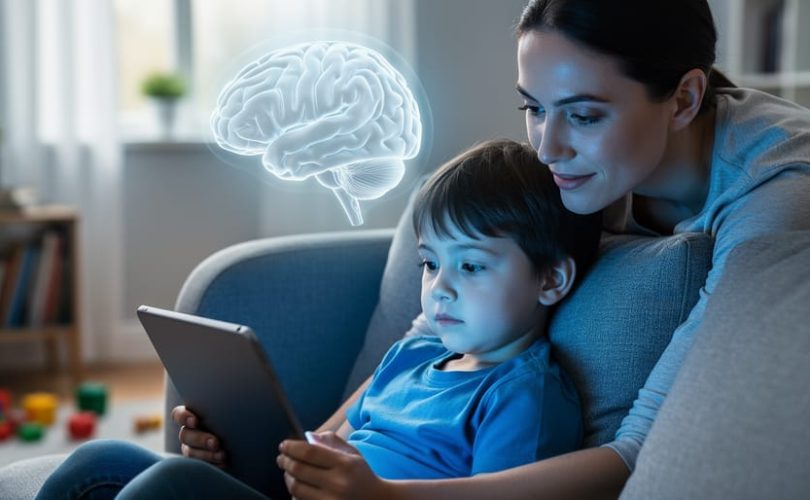
Video brain development refers to the measurable changes in children’s brain structure, function, and connectivity that occur in response to screen-based media exposure, particularly during the critical early years when neural pathways are rapidly forming.
If you’re reading this, you’ve likely noticed your child drawn to screens and wondered what’s happening beneath the surface. You’re not alone. The average child now encounters digital media before their first birthday, and many parents find themselves caught between the convenience screens offer and nagging worry about long-term effects. Understanding how video content shapes your child’s developing brain isn’t about stoking fear or adding to parenting guilt. It’s about making informed choices that fit your family.
The research tells us something important: not all screen time affects the brain equally. A toddler passively watching rapid-fire cartoons experiences different neurological impacts than a school-age child video-calling grandparents or creating digital art. Context matters. Content matters. Your child’s age matters profoundly.
Recent neuroimaging studies show that excessive screen exposure during early childhood correlates with differences in white matter development, the brain tissue supporting language and literacy skills. At the same time, interactive educational content has demonstrated benefits for specific cognitive skills when used appropriately. The key word? Appropriately.
This article will help you understand exactly how video content influences your child’s developing brain, what warning signs deserve attention, and how to create a balanced media environment that supports healthy neurological growth. You’ll find practical guidance rooted in current research, not judgment. Because the goal isn’t eliminating screens entirely from modern childhood. It’s understanding how they work in the brain so you can make choices that protect what matters most: your child’s cognitive potential and emotional wellbeing.
What Video Brain Development Means for Your Child
Your child’s brain is actively building itself throughout childhood, constantly forming new connections and pathways based on what they experience each day. This process, called neuroplasticity, means that everything your child encounters, including video content, literally shapes how their brain develops and functions.
Think of the young brain as remarkably receptive to its environment, almost like wet clay that holds the imprint of whatever touches it. When your child watches videos, their brain isn’t just passively receiving images. It’s actively responding, forming neural pathways, and adapting its structure based on the content, frequency, and context of that viewing. This isn’t inherently good or bad, but it does mean that screen experiences matter in ways that go beyond what we immediately see.
The first years of life represent critical developmental windows when specific brain regions are particularly sensitive to environmental input. During these periods, certain capabilities, language, social bonding, emotional regulation, are being fundamentally established. What your child experiences during these windows can have lasting effects on how easily they’ll develop these skills.
- Neuroplasticity
- The brain’s ability to reorganize itself by forming new neural connections throughout life, especially pronounced in childhood when experiences literally shape brain structure.
- Executive Function
- Higher-level cognitive abilities including planning, decision-making, impulse control, and flexible thinking, primarily governed by the prefrontal cortex which develops well into young adulthood.
- Attention Regulation
- The brain’s capacity to focus on relevant information while filtering out distractions, a skill that develops through practice and can be affected by overstimulating media.
- Reward Pathways
- Neural circuits involving dopamine that signal pleasure and motivation, which can be triggered by fast-paced video content and shape what the brain learns to seek out.
Understanding video brain development doesn’t mean panicking about every minute of screen time. Rather, it helps you recognize that your child’s brain is learning from everything it encounters. Video content teaches the brain what to pay attention to, what feels rewarding, and how to process information. When screen time is excessive or replaces essential experiences like conversation, play, and physical exploration, the brain adapts to those circumstances, potentially developing patterns that don’t serve your child well in other contexts.
The vulnerability of the young brain to screen influence stems from its very strength, its remarkable ability to adapt and learn from the world around it.
How Video Content Affects the Developing Brain

Attention and Focus Pathways
When your child watches a video, each rapid scene change triggers a small release of dopamine in their brain’s reward center. This feels good, which is why kids can sit mesmerized for hours. However, frequent dopamine spikes from fast-paced content can create a feedback loop where the brain craves constant stimulation. Over time, children may struggle to engage with activities that don’t provide the same level of rapid novelty, like reading a book or listening to a teacher explain a concept.
Research from neuroscience labs shows that the prefrontal cortex, which governs sustained attention and impulse control, develops differently in children with heavy screen exposure. Unlike active play or conversation, passive video viewing doesn’t require kids to generate focus themselves. The screen does the work of grabbing attention through bright colors, loud sounds, and quick cuts. This means the neural pathways for self-directed attention get less practice.
The good news? These effects aren’t permanent. Young brains remain plastic and responsive. When you protect focus with play and offer screen-free time for imaginative activities, your child’s brain strengthens its capacity for sustained, voluntary attention. The key is understanding that what feels entertaining to your child might be training their brain to expect constant stimulation, making slower-paced learning feel harder than it needs to be.
Language and Social Development
Video screens don’t talk back, and that matters enormously for language development. When a toddler watches a character speak on screen, the language centers in the left hemisphere receive input but miss the crucial feedback loop that occurs during face-to-face conversation. Real human interaction activates Broca’s area (speech production) and Wernicke’s area (comprehension) simultaneously as children practice turn-taking, read facial expressions, and adjust their communication based on responses. Passive video viewing lights up comprehension regions but leaves production pathways relatively dormant.
The distinction between interactive and passive screen time becomes especially clear in language outcomes. Video chat with grandparents, where a child asks questions and receives personalized responses, supports language growth in ways that watching educational programming alone cannot. Studies consistently show that children under three learn vocabulary far more effectively from a live person than from the same lesson delivered via screen, even when the content is identical.
Social-emotional processing takes a similar hit. The brain’s mirror neuron system, which helps children understand emotions and develop empathy, requires real-time observation of human faces and bodies. Screen characters move differently than real people, expressions are exaggerated or simplified, and the vital practice of reading subtle social cues gets replaced with scripted interactions. The amygdala and prefrontal cortex, which work together to process emotional information and regulate responses, develop through thousands of small social exchanges that screens simply cannot replicate. Heavy video exposure during critical periods can also produce working memory effects that further complicate learning.
Memory and Learning Centers
Video content fundamentally alters how children’s brains process and store information. The hippocampus, your child’s memory center, develops through active engagement with the world. When children watch videos passively, they’re not creating the rich sensory connections that strengthen memory formation. Research shows that children recall significantly less from video content compared to real-world experiences or interactive play.
Working memory, the mental workspace kids use to hold and manipulate information, particularly struggles with video overload. Rapid scene changes and constant visual stimulation can overwhelm this system, making it harder for children to filter what’s important from what’s just noise. You might notice your child has trouble following multi-step instructions after extended screen time.
The encoding process suffers too. When information comes too quickly or without context, young brains can’t properly transfer it from short-term to long-term storage. It’s like trying to file papers while someone keeps tossing new ones at you. Children need time to process, reflect, and connect new information to what they already know, something passive viewing rarely provides.
Sleep and Emotional Regulation
Video content affects two critical brain systems that work together to manage sleep and emotions. The prefrontal cortex, which handles impulse control and emotional responses, develops throughout childhood and is particularly vulnerable to disruption. Meanwhile, the limbic system, our emotional processing center, becomes dysregulated when screens interfere with natural sleep-wake cycles.
Blue light from screens suppresses melatonin production, the hormone that signals bedtime. When children watch videos before bed, their brains stay alert when they should be winding down. This isn’t just about feeling tired the next day. Poor sleep directly impacts the prefrontal cortex’s ability to regulate emotions, leading to increased irritability, meltdowns, and difficulty managing frustration.
Research shows children who use screens heavily often struggle with mood regulation even during daytime hours. The constant stimulation keeps their nervous systems in a heightened state, making it harder to self-soothe or transition between activities. The developing brain needs adequate sleep to consolidate learning and process emotions, when video exposure disrupts this cycle, it creates a cascade effect on overall emotional wellbeing and behavioral control.
Different Types of Screen Exposure and Their Effects

Passive Video Viewing vs. Interactive Content
When your child watches a cartoon without interacting, their brain receives information but doesn’t send anything back. This one-way flow limits the neural pathways that develop during screen time. Passive viewing activates fewer brain regions than active engagement, particularly in areas responsible for problem-solving and executive function.
Interactive content changes this equation. When a program pauses for your child to answer questions, or a game requires decision-making, multiple brain areas light up simultaneously. The frontal lobe engages to plan responses, language centers activate to formulate answers, and motor regions coordinate physical interactions.
Research shows that toddlers learn vocabulary more effectively from apps that respond to their touch than from videos that simply play. The back-and-forth mirrors human conversation, which remains the gold standard for brain development.
However, not all interactive content delivers equal benefits. A game requiring mindless tapping differs significantly from one that adapts to your child’s learning level and provides meaningful feedback. True interactivity involves cognitive effort, not just finger movement.
Educational vs. Entertainment Media
Educational programming designed for children activates different neural pathways than purely entertainment content. When children watch shows that pause for responses, repeat key concepts, or follow predictable learning structures, their brains engage in active processing rather than passive reception. Research tracking brain activity shows that educational content lights up areas associated with memory formation and problem-solving, while fast-paced entertainment primarily stimulates the brain’s reward centers without building lasting neural connections.
The distinction matters more than screen time alone. A preschooler watching a thoughtfully paced educational program about shapes may strengthen visual-spatial reasoning skills, while the same amount of time watching rapid-fire cartoons offers minimal cognitive benefit. Quality educational content includes clear learning objectives, age-appropriate pacing, and opportunities for the child to predict or respond, even if just mentally.
However, even excellent educational media cannot replace hands-on learning. The brain develops most robustly through direct experience, touching objects, conversing with caregivers, and moving through physical space. Educational screens work best as supplements, not substitutes, for real-world exploration.
Age-Appropriate Content Considerations
Children’s brains develop in distinct stages, which means a show perfectly suitable for a seven-year-old can overwhelm or confuse a toddler.
Under age two, brains are wired for face-to-face interaction. Even high-quality educational content falls flat because infants and toddlers can’t yet transfer what they see on screen to real-world understanding. Their brains need three-dimensional, tactile experiences to build foundational neural connections.
Preschoolers (ages 3-5) are developing symbolic thinking and language skills rapidly. They benefit most from slow-paced, repetitive content with clear narratives. Fast cuts, abstract concepts, and complex storylines can frustrate rather than educate because their prefrontal cortex, the brain region handling planning and comprehension, is still immature.
School-age children have more developed cognitive control and can handle nuanced storylines, but their emotional regulation centers are still forming. Content with intense conflict, frightening imagery, or complex moral dilemmas may trigger stress responses they’re not yet equipped to process.
The same cartoon that entertains and teaches a kindergartener might bore an older child or overstimulate a toddler. Matching content to developmental capacity isn’t about being overprotective, it’s about respecting how their brains actually work at each stage.
When Screen Time Becomes a Concern
Recognizing when your child’s screen habits need adjustment isn’t about measuring minutes on a timer, it’s about noticing changes in how they function and interact with the world around them.
Most parents instinctively sense when something feels off. Your typically chatty toddler suddenly seems quieter, or your preschooler melts down every time you suggest putting the tablet away. These shifts often signal that video exposure is outpacing your child’s developmental capacity to process it healthily.
Watch for these warning signs that screen time may be affecting development:
- Difficulty maintaining attention during non-screen activities like reading books or playing with toys
- Speech delays or reduced vocabulary growth compared to age-appropriate milestones
- Sleep problems including difficulty falling asleep, frequent night waking, or daytime drowsiness
- Increased irritability, aggression, or emotional meltdowns particularly when screens are removed
- Declining interest in physical play, outdoor activities, or movement-based games
- Social withdrawal from family interactions or difficulty engaging with peers
Context matters enormously. A child who occasionally struggles to transition away from a favorite show differs vastly from one who exhibits multiple concerning behaviors persistently over weeks. Consider the pattern rather than isolated incidents.
Trust yourself to know what’s normal for your child. If your kindergartener who previously loved drawing now only wants screen time, or your baby seems less responsive to your voice after increased video exposure, those observations are valid.
When should you seek professional guidance? If developmental milestones are noticeably delayed, if your child’s behavior has significantly changed and standard adjustments aren’t helping, or if screen dependence is disrupting family functioning and your child’s ability to participate in essential daily activities, reach out to your pediatrician. They can assess whether brain development is progressing typically and connect you with appropriate support if needed.
Remember that early intervention makes a meaningful difference. Asking for help demonstrates strength and commitment to your child’s wellbeing, not parental failure.
Supporting Healthy Brain Development in a Digital World

You don’t need to eliminate screens entirely to support healthy brain development. Start with boundaries that work for your family: the American Academy of Pediatrics recommends no screen time for children under 18 months (except video chatting), one hour daily of high-quality programming for ages 2-5, and consistent limits for older children. What matters most is how you integrate screen time into a rich, varied day rather than treating it as a moral failure when your child watches something.
Co-viewing transforms passive consumption into active learning. When you watch with your child, pause to ask questions, relate content to their experiences, or extend ideas into real-world activities. A child who watches a cooking show with you and then helps measure ingredients in the kitchen engages different neural pathways than one who watches alone. This interaction helps the prefrontal cortex practice critical thinking rather than simply absorbing stimuli.
Content quality genuinely matters for brain development. Programs with slower pacing, coherent narratives, and educational goals support attention and language centers more effectively than rapidly-edited entertainment. Look for content that encourages participation, uses age-appropriate language, and relates to concepts your child encounters offline. When you can’t vet every show, reputable sources like PBS Kids or Common Sense Media provide reliable guidance.
Create tech-free zones and times that protect critical developmental activities. Keep devices out of bedrooms to safeguard sleep architecture. Establish screen-free mealtimes to support face-to-face communication and language development. The hour before bed should be device-free since blue light exposure disrupts melatonin production and sleep quality, which the developing brain desperately needs for memory consolidation and emotional regulation.
Balance screen time with activities that actively build neural connections. How play rewires the brain through hands-on exploration, problem-solving, and social interaction in ways passive viewing cannot replicate. Understanding the brain science behind play helps you prioritize unstructured time outdoors, creative projects, and peer interaction. Physical activity, adequate sleep, and attention to nutrition brain development provide the foundation healthy brains need to thrive, whether screens are present or not.
Model the relationship with technology you want your child to develop. Children observe how you use devices, when you prioritize presence over phones, and how you manage your own attention. Your behavior teaches more powerfully than any rule.
What Parents Often Ask About Video and Brain Development

Can brain changes from excessive screen time be reversed?
Yes, the brain’s neuroplasticity means that many effects of screen overexposure can improve with changes in habits. When children engage in more face-to-face interaction, physical play, and offline enrichment their brains can develop new pathways and strengthen areas that may have been underdeveloped.
Are all screens equally harmful to brain development?
No. The content matters more than the device itself. A video chat with grandparents where your child actively participates differs significantly from passive viewing of fast-paced cartoons. Interactive, age-appropriate educational content affects the brain differently than overstimulating entertainment.
Do educational apps really help brain development?
Quality educational apps can support learning, but they work best as supplements rather than replacements for hands-on activities. Apps that require problem-solving and respond to your child’s input tend to be more beneficial than those that simply entertain, though real-world experiences still provide richer developmental benefits.
How much screen time is actually too much for my child’s brain?
It depends on age. For children under 18 months, video chatting is the only recommended screen use. Ages 2-5 benefit from no more than one hour daily of high-quality content with parent co-viewing, while school-age children need limits that still allow time for sleep, physical activity, and offline play.
When should I worry that screens are affecting my child’s development?
Watch for persistent signs like difficulty making eye contact, delayed speech compared to peers, inability to play independently without screens, frequent tantrums when devices are removed, or disrupted sleep patterns. If these concerns last beyond a few weeks despite reducing screen time, talk with your pediatrician.
Is video chatting with relatives harmful to my toddler’s brain?
Video calls with family members are different from passive screen time because they involve real-time, responsive interaction. This back-and-forth communication supports language development and social connection, making it the one type of screen time recommended even for very young children.
These questions reflect the real anxieties parents carry, and the answers matter because guilt helps no one. What you’re looking for isn’t perfection in screen management but rather a sense of whether your child’s overall development is on track. Trust your instincts. If your four-year-old watches an extra episode on a difficult day, that’s not going to rewire their brain permanently. But if screens have become the primary way your child spends time, or if you’re noticing the warning signs we discussed earlier, that’s your cue to make some adjustments. Remember that every family’s situation is unique, and small, consistent changes tend to work better than dramatic overhauls that nobody can sustain.
Understanding how video content shapes your child’s developing brain isn’t about achieving perfection or eliminating screens entirely. It’s about making informed choices that work for your family’s unique situation.
You now have the knowledge to recognize when screen time supports your child’s development and when it might be getting in the way. That awareness alone changes how you approach daily decisions about media use.
Parenting in a digital world is genuinely challenging. You’re navigating territory that didn’t exist when you were growing up, often without clear guidelines or community consensus. There will be days when screen time exceeds your intentions, and that’s okay. One afternoon of extra tablet time doesn’t rewire your child’s brain or undo months of thoughtful parenting.
What matters most is the overall pattern you create: the conversations you have during shows, the active play that balances screen time, the connection you maintain with your child regardless of what’s happening on a screen.
Start small if you’re feeling overwhelmed. Pick one change that feels manageable, maybe screen-free mealtimes, or co-viewing one show each week, or establishing a consistent bedtime routine without devices. Build from there as these habits become natural.
Connect with other parents who share your values around media use. You’ll find reassurance, practical strategies, and the reminder that you’re not alone in these decisions.
Your child’s brain is remarkably resilient and responsive. The intentional choices you make today, informed by understanding rather than fear, create the foundation for healthy development tomorrow.