

Showing 4 Result(s)
Parent and child sitting cross-legged together in a calm living room, practicing a quiet breathing and grounding meditation.

How to Practice 2-Minute Anxiety Meditation with Your Child

A two-minute anxiety meditation is a brief breathing and grounding exercise that helps calm an anxious child’s nervous system in real time. When your child is spiraling with worry, racing thoughts, or physical tension, this practice works because it triggers the body’s relaxation response through intentional breath control and present-moment awareness. You don’t need special equipment, a quiet room, or prior meditation experience. Just two minutes of guided breathing can shift a child from fight-or-flight mode to a calmer state.
As a parent watching your child struggle with anxiety, you’ve likely felt that …
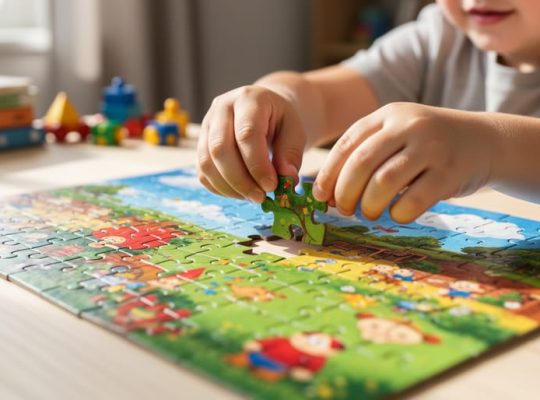

Close-up of a child’s hands placing a jigsaw puzzle piece into a colorful puzzle on a table, with other learning items softly blurred in the background.

What Are the Cognitive Benefits of Jigsaw Puzzles (and How Do They Help Your Child’s Brain)?

Cognitive benefits of jigsaw puzzles refer to the measurable improvements in mental abilities that occur when children and adults regularly engage with these hands-on spatial challenges. This includes sharper visual-spatial reasoning, stronger short-term memory, better problem-solving skills, and improved attention span.
If you’ve watched a child hunched over a puzzle, quietly sorting edge pieces or testing where a tricky sky fragment belongs, you’ve witnessed active brain development in real time. The appeal of jigsaw puzzles lies in their deceptive simplicity: they look like mere entertainment, yet neuroscience …

A family enjoying a board game together in a cozy, warm setting, symbolizing breaking free from phone addiction and achieving digital balance.

Break Free From Phone Addiction: A Parent’s Path to Digital Balance

Take back control of your family’s digital life without guilt or shame. In today’s hyper-connected world, our phones have become both invaluable tools and subtle disruptors of meaningful family connections. As a parent and family therapist, I’ve witnessed countless families transform their relationships by implementing a structured phone detox plan – and yours can too.
The constant notifications, endless scrolling, and digital distractions affect more than just our time; they impact our children’s developing minds, our family dynamics, and our overall well-being. Studies show that excessive screen time …

A group of preschool children working together to build an elaborate block tower, demonstrating teamwork and communication.

How Cooperative Play Transforms Your Child’s Social Development

Picture a group of preschoolers working together to build an elaborate block castle, each child contributing ideas and pieces while sharing tools and encouragement. This is cooperative play at its finest – a crucial developmental milestone where children learn to work together toward common goals, share resources, and support one another’s success. Unlike parallel or solitary play, cooperative play represents a sophisticated level of social interaction where children actively engage with peers, negotiate roles, and solve problems as a team.
When children engage in cooperative play, they’re not just having fun &#…