
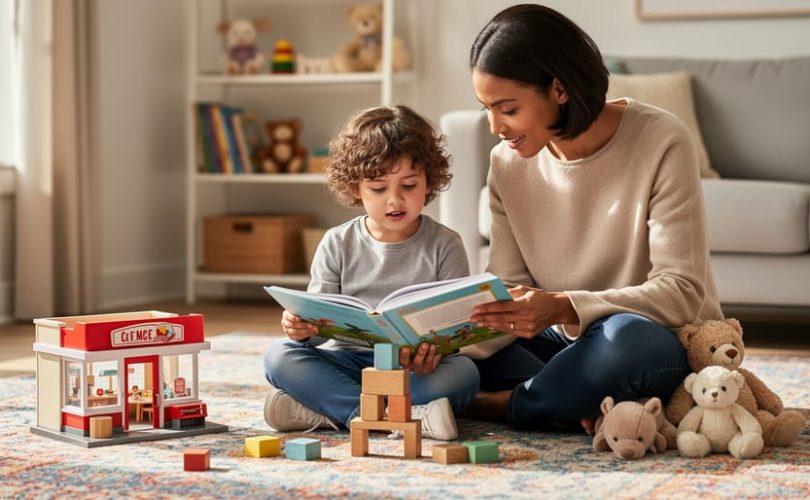
The 7 play languages are pretend, movement, building, sensory, creative play, game, and quiet play. Each one is a different way children explore the world and practice the words, ideas, and feelings they’re still learning to express. When you add storytelling to any of them, you give a child’s language a natural place to grow. It takes about 10 to 15 minutes, needs no special training, and works with whatever you already have at home or in the classroom.
Here’s why it works. Children rarely build vocabulary from flashcards or direct questions. They build it while they’re absorbed in something, whether that’s a pretend restaurant, a block tower that needs a name, or a quiet corner with a favorite picture book. A story gives that play a beginning, a middle, and an end, and that structure is exactly what language development leans on.
Most children have one or two languages they reach for first. A child who seems reluctant to talk may simply be fluent in movement or building instead. That’s not a problem to fix. It’s a doorway.
This guide defines each of the seven, then walks you through simple storytelling activities, the materials you’ll need, safety points, and how to tell whether it’s working.
What the 7 Play Languages Are and Why They Support Speech and Storytelling
The seven play languages are pretend, movement, building, sensory, creative, game, and quiet play. Each one gives a child a different doorway into words and stories, which is why storytelling play works so well across all of them.
Here’s what each one supports:
– Pretend play builds narrative skills and perspective-taking, as children give characters voices and feelings.
– Movement play builds action words, prepositions, and sequencing, because children learn “over,” “under,” and “first, then” with their whole bodies.
– Building play builds spatial words and ordering, like “taller,” “beside,” and “next.”
– Sensory play builds descriptive vocabulary, such as squishy, smooth, and cold.
– Creative play builds the confidence to describe ideas and explain what they made.
– Game play builds turn-taking, listening, and following directions.
– Quiet play builds retelling, imagination, and comfortable independent language.
Most children lean toward one or two of these. A child who skips pretend play but builds for an hour isn’t behind. They’re simply telling you where they feel safest, and that preference is a useful clue about where to start.
Speech-language pathologists often describe play as the natural classroom for young children. As one child development specialist puts it, “Children don’t learn language from drills. They learn it from doing things they care about, with someone who talks along with them.” The words stick because they’re tied to action, feeling, and connection.
One mother told me about her four-year-old, who barely spoke in new situations. He loved building, so she started stacking blocks beside him and quietly narrating: “A tall tower. Who lives up there?” Within a couple of weeks, he was inventing a whole family of dragons and telling her what each one wanted for dinner. The building gave him something to say before he had to say it to anyone’s face.
What You’ll Need: Simple Tools and Materials for Story Play
You don’t need a shopping trip to start. Most story play runs on things already in your home, and your child cares far more about your attention than about fancy equipment. Here’s a simple checklist, grouped by the seven play languages:
- Pretend play: stuffed animals, a few puppets or socks with faces drawn on, and a scarf or two for capes and costumes.
- Movement play: a cleared patch of floor, pillows to hop over, and a long piece of string or tape for a “path.”
- Building play: wooden blocks, plastic cups, or a cardboard box that can become a castle, boat, or rocket.
- Sensory play: playdough, a bowl of dry rice or oats, or a basin of water with a few spoons and cups.
- Creative play: paper, crayons, and washable markers for drawing characters and scenes.
- Game play: a simple board game, a die, or a deck of picture cards for taking turns.
- Quiet play: a handful of favorite picture books and a cozy blanket for a reading nook.
Many of these items pull double duty. A scarf works as a river in pretend play and a prop in movement play, and a cardboard box can hold a story world for building or a hiding spot for quiet time.
Adapt freely to fit your child. For toddlers, choose larger pieces and taste-safe textures. For children who dislike messy hands, offer a spoon, a zip bag of playdough, or a sealed sensory bag. For children with different motor or sensory needs, swap in softer, lighter, or easier-to-grip items. There’s no right setup, only the one that feels comfortable for your child.
Safety First: Keeping Story Play Comfortable and Safe
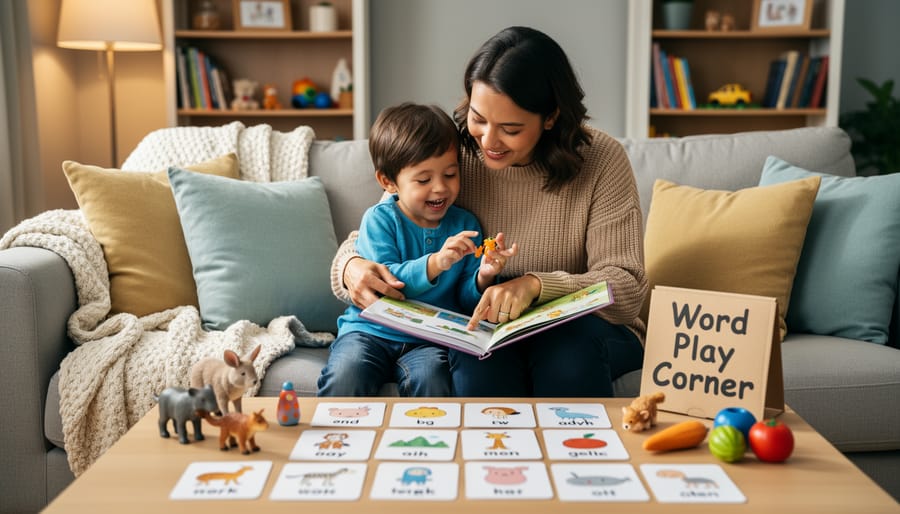
Story play works best when a child feels safe, so a few simple checks are worth doing before you start. For little ones, look for small parts choking hazards in blocks, figurines, and craft supplies, and choose taste-safe options for sensory play, such as cooked pasta or plain oats, if your toddler still puts things in their mouth. Clear a soft, open space before movement play, and tuck away anything sharp or wobbly.
Your child will tell you what they need, often without words. Turning away, going quiet, crying, rushing through the activity, or saying “all done” are gentle signals to pause. Follow those cues rather than pushing through. If your child resists one of the seven play languages, put it aside and come back another day. Children who feel pressure rarely open up, and that’s not a failure on anyone’s part.
This looks different in each kind of play. Quiet reading corners suit a child who needs a break, while role-play stories may need a pause if a scene feels scary. Slow down cooperative games if frustration builds, and keep art integration projects relaxed and judgment-free.
If you have ongoing worries about your child’s speech or language milestones, a quick check-in with your pediatrician or a speech-language pathologist can bring real reassurance. Asking early is simply good care.
Step-by-Step: Weaving Language Into Each of the 7 Play Languages
Pretend Play: Acting Out the Story
Grab a few puppets, stuffed animals, or a scarf for a cape, and let your child act out a story they already love, or invent a new one together. Start by following their lead. If your child says, “Bear walk,” you might respond, “The big bear is walking through the dark forest!” That models new words without correcting them.
Then get curious: “What do you think happens next?” Open questions invite longer answers than yes-or-no ones. When your child offers a short phrase, gently stretch it. “Bear sleepy” becomes “The bear is sleepy because he’s had a long day.” Keep it playful, and let them steer the plot.
Movement Play: Moving Through the Story
Some children need to move to make sense of a story. Try turning a favorite tale into an action adventure: hop like the frog, tiptoe past the sleeping bear, crawl under the “bridge” of a couch cushion.
Notice how many useful words show up naturally. You can say, “First we hop over the log, then we creep behind the tree.” Words like over, under, behind, first, and then give your child a feel for prepositions and sequencing in their own body.
Pause and ask, “What should we do next?” Let your child choose the next move and describe it, even if it’s just one word.
Building Play: Constructing the Story World
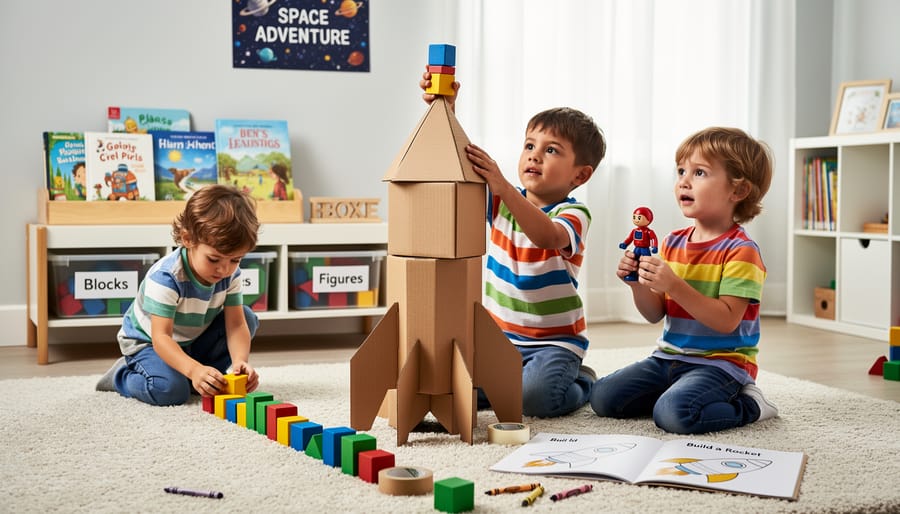
Grab some blocks, a big cardboard box, or a few couch cushions and build a world together. A castle, a farm, a rocket ship, anything your child dreams up. Then ask, “Who lives here?” and let the story begin.
As you build, sprinkle in position and size words: “The dragon sleeps under the bridge,” “Your tower is taller than mine,” “The cow is beside the barn.” These are spatial words children pick up best through doing.
Next, notice cause and effect. “Uh-oh, the wall fell down. What should the knight do now?” You’re modeling how to explain what happened and what comes next, and a collapsed tower becomes the best plot twist in the story.
Sensory Play: Feeling the Story
Fill a shallow bin with dry rice, oats, or water, then add a few small toys and let a story begin. Maybe the dinosaur is stuck in a swamp, or the ducks are having a bath. As your child plays, offer words for what their hands discover: “That feels squishy!” “Ooh, the water’s so cold.”
Ask gentle questions like, “What does the dinosaur feel under his feet?” Sensory-seeking children often settle into this kind of play and find words more easily when their hands are busy.
If messy textures feel uncomfortable, try a tool with a handle, like a spoon or scoop, or put the bin inside a zip bag. You can also offer smooth, dry materials, and leave out anything they’d rather not touch.
Creative Play: Drawing and Making the Story
Set out paper, crayons, or paint and invite your child to make a character or a scene from a story. Then, once they’ve finished, simply ask, “Can you tell me about this?” That one open question does a lot of work. Your child has to describe what they made, put events in order, and decide what matters most.
Try to avoid “What is it?” or “That’s a lovely horse.” Instead, notice what’s there: “I see a lot of blue here. What’s happening in this part?” When a child feels listened to rather than graded, they share more ideas, and their confidence grows with each retelling.
Game Play: Taking Turns in the Story
Game play gives children a fun reason to practice the back-and-forth of conversation. Try story dice, where each roll becomes a character or setting you weave into a tale. Or play “add one sentence each,” taking turns building a story together. You might say, “Your turn! What does the dragon do next?” Simple board games work too, since following the rules means listening and waiting.
Losing can feel big to little ones. Name the feeling kindly (“That’s disappointing, isn’t it?”), and try cooperative games where everyone wins together.
Quiet Play: Cozy, Solo, and Book-Based Storytelling
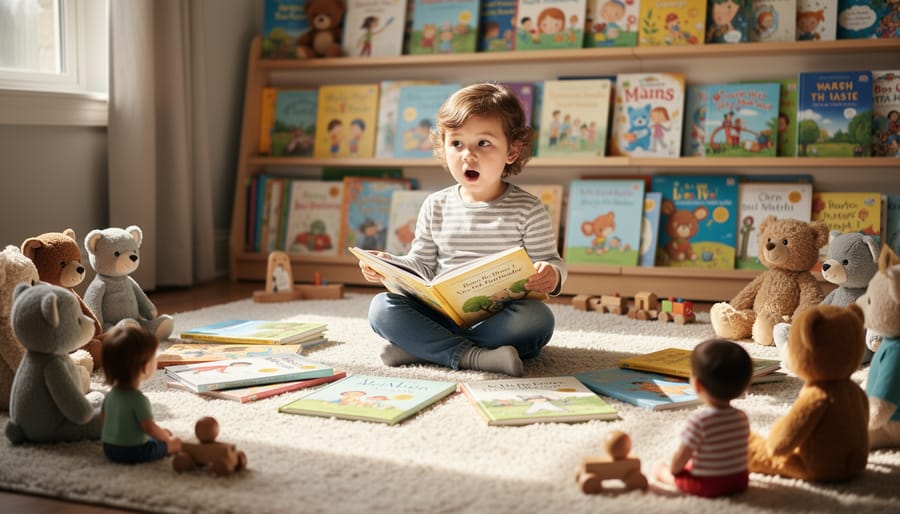
Quiet play gives a child room to slow down and let language settle. Try a picture walk: look through a book together first, talking about what you see before reading a single word. “Who do you think this character is?” Afterward, invite your child to retell the story in their own words, or tell it to a favorite stuffed animal. Some children simply need a cozy corner with a blanket and a few books, and that counts as play. Shy or easily overstimulated children often do their best storytelling in these calm, low-pressure moments, so let them lead and welcome the quiet.
Finding Your Child’s Favorite Play Languages
Watch what your child chooses when nobody is steering. Do they line up toy animals and narrate a scene (pretend play)? Dash off to climb and jump (movement play)? Stack blocks into towers (building play)? Dig into dough or water (sensory play)? Reach for crayons (creative play)? Ask for a board game (game play)? Or curl up with a book and a stuffed animal (quiet play)? Whatever they return to again and again is a favorite, and it’s your easiest doorway into language.
Once you know the favorite, borrow it. A child who loves building can “build” a story, adding a character and a problem to the castle. A mover can act out a tale on the way to the sofa, where a picture book waits.
Child therapists and early childhood educators often say the same thing: follow the child’s lead, then widen the circle gently. When children feel in charge, they relax, and relaxed children talk more.
A kindergarten teacher once told me about a boy who wouldn’t join story time. He wandered, fiddled, and never spoke up. She noticed he always touched the texture wall, so she set up a small sensory tub with dried beans and a few toy animals. Within a week he was whispering a story about a lost sheep. By the next month he was telling it to the group, mostly because she’d met him where he already felt safe.
This kind of play-based learning works best when we let go of the idea that a child must like everything.
Preferences shift with age, mood, and season. A child who avoids game play at four may love it at six. Keep offering gently, with no pressure.
How to Tell It’s Working and What to Try Next
You’ll rarely see a big leap overnight. Progress with play-based storytelling shows up in small, quiet ways, and noticing them helps you keep going. Look for a new word popping up mid-play, a sentence that’s one word longer than last week, or more back-and-forth where your child answers and then asks you something. The sweetest sign is when your child starts a story on their own, whether it’s a puppet adventure or a block castle with a whole cast of characters.
A simple play journal makes these moments easier to spot. After a session, jot down two or three lines: which play language you used, a new word or phrase you heard, and how your child seemed to feel. Over a few weeks, patterns appear, and you’ll see what lights them up.
If play feels like a struggle, adjust rather than push. Switch to a different play language, shorten the session, or take a few days off. Try rotating one play language each week, and fold the ideas into bath time, car rides, or circle time at school. If you still have concerns about speech or language milestones, a pediatrician or speech-language pathologist can offer helpful guidance. Every child moves at their own pace, so there’s no need to compare.
Common Questions About Play-Based Storytelling
Parents and educators often ask the same handful of things when they start story play. Here are short, honest answers, using the same seven play languages as the rest of this article: pretend, movement, building, sensory, creative, game, and quiet play.
How long should we play each day?
Ten to fifteen minutes of focused, child-led play is plenty. A short session where you’re fully present beats a long one where you’re distracted.
What if my child won’t join in?
Step back and play alongside them, narrating what they do. Try a different play language, since a child who resists pretend play may love building or quiet play.
Do screens count as play?
Not really, because story play grows from back-and-forth with you. If you do watch a show together, you can turn it into pretend or creative play afterward by acting out or drawing a favorite scene.
How does this help bilingual children?
Story play works in any language, and you can tell stories in the language you feel most at home in. Children build vocabulary and sequencing skills that carry across both languages.
Can this work in a classroom?
Yes. Rotate small stations, such as a building corner, a sensory bin, and a cozy book nook, and add a game play story chain for the whole group.
When should we seek professional support?
If you have ongoing worries about your child’s speech or language milestones, a pediatrician or speech-language pathologist can help. Asking early is a caring step, not an overreaction.
Whatever questions come up for you, remember that there’s no single right way to play. Follow your child’s cues, keep it relaxed, and trust that small, warm moments of storytelling add up over time.
Every child has their own way into language. Some find it through pretend play, some through movement play, and others through building play or sensory play. Creative play, game play, and quiet play open doors too. None of these is better than another, and your child’s favorites are simply where they feel safe enough to try new words.
So this week, pick one small play session. Ten minutes with a stuffed animal and a made-up story is plenty. Connection matters far more than perfection. If something worked for your family, share it with our community.