
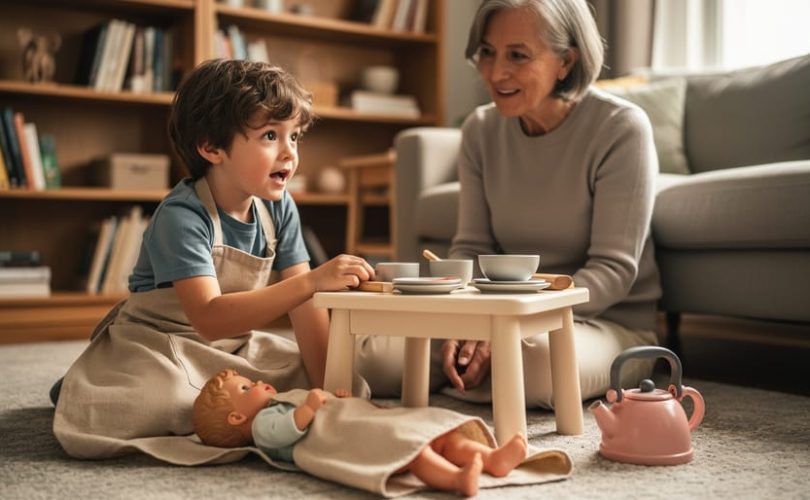
Role-play stories are the narratives children create and act out when they take on different characters, scenarios, and emotions through imaginative play. A four-year-old becomes a veterinarian caring for stuffed animals, a six-year-old transforms into a superhero saving the world, or siblings recreate a family dinner with dolls seated around a miniature table. These spontaneous performances are far more than entertainment. They’re essential cognitive and emotional rehearsals that help children make sense of their experiences, practice social skills, and build the foundation for empathy and problem-solving.
If you’ve ever watched a child slip seamlessly between roles or narrate an elaborate adventure with toys, you’ve witnessed role-play stories in action. Yet many parents and educators wonder what these stories reveal about a child’s inner world, when to encourage them, and how to respond when the themes feel confusing or intense.
This article explains what role-play stories are, how they support healthy development, and the different forms they take across childhood. You’ll find practical guidance on creating environments that nurture this type of play, along with expert perspectives on common concerns. Whether you’re observing a toddler’s first pretend phone call or a school-age child’s complex fantasy game, understanding role-play stories gives you insight into how children learn to navigate relationships, regulate emotions, and imagine possibilities beyond their immediate reality.
What Role-Play Stories Mean for Your Child
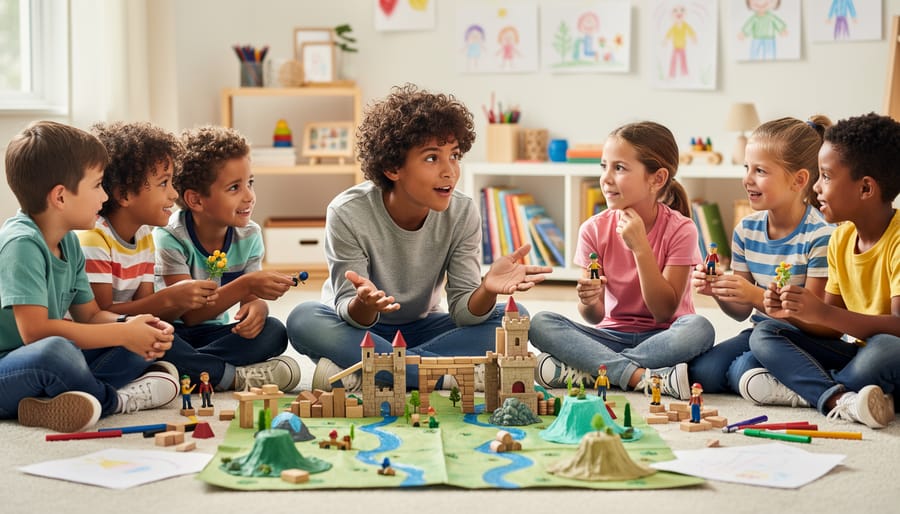
Role-play stories sit at the intersection of two powerful childhood activities: pretend play and storytelling. When your four-year-old announces, “I’m the doctor and you’re sick,” then proceeds to examine you with a toy stethoscope while narrating what’s wrong and how to fix it, they’re engaging in role-play stories. This isn’t just random make-believe, it’s structured imaginative play where your child creates characters, builds a scenario, and follows a narrative thread from beginning to end.
The key difference between role-play stories and other forms of play lies in the narrative element. A child stacking blocks is playing, but a child building a castle for a trapped princess who needs rescuing is telling a story through action. Similarly, listening to you read a bedtime story is passive storytelling, while acting out that same story, assigning roles, improvising dialogue, deciding what happens next, transforms it into active role-play. Your child becomes both author and actor, controlling the plot while living inside it.
- Narrative play
- Play that follows a story structure with a beginning, middle, and end, rather than random or repetitive actions.
- Symbolic thinking
- The ability to let one thing represent another, a stick becomes a sword, a box becomes a spaceship, which underlies all pretend play.
- Pretend scenarios
- Imaginary situations children create and act out, from everyday activities like cooking to fantastical adventures like flying to the moon.
- Character embodiment
- When a child fully takes on a role, adopting different voices, mannerisms, and perspectives of the character they’re playing.
This type of play emerges gradually as pretend play grows across years. Around 18 months, toddlers begin simple pretend actions, feeding a doll, talking on a toy phone. By age three, they’re creating brief scenes with clear roles. Between four and seven, role-play stories become more complex, with multiple characters, longer plots, and elaborate rules. Even as children enter school age, this narrative play continues evolving, often incorporating more sophisticated themes and collaborative storytelling with peers.
How Role-Play Stories Work in Children’s Minds
The Building Blocks of a Role-Play Story
Even the simplest role-play contains the same story elements you’d find in a book or film. When your three-year-old announces “I’m the mummy and you’re the baby,” they’ve just created characters and established a setting (home). What happens next, maybe the baby won’t eat breakfast, or needs a bath, introduces conflict. The resolution comes when the problem gets solved, even if it’s just pretending to feed the baby or put them to bed.
Children don’t consciously plan these elements. They emerge naturally through play. A child playing “restaurant” instinctively creates a space (the kitchen becomes the dining room), assigns roles (chef, customer, waiter), introduces a problem (the food is too hot, someone ordered something not on the menu), and works toward a solution.
These building blocks grow more sophisticated as children develop. A toddler’s story might be simple: “Baby crying. Give bottle. Baby happy.” By age five or six, the same child might weave elaborate plots with multiple characters, unexpected twists, and creative problem-solving. The narrative structure is there from the start, it just becomes richer and more complex over time.
From Solo Play to Social Storytelling
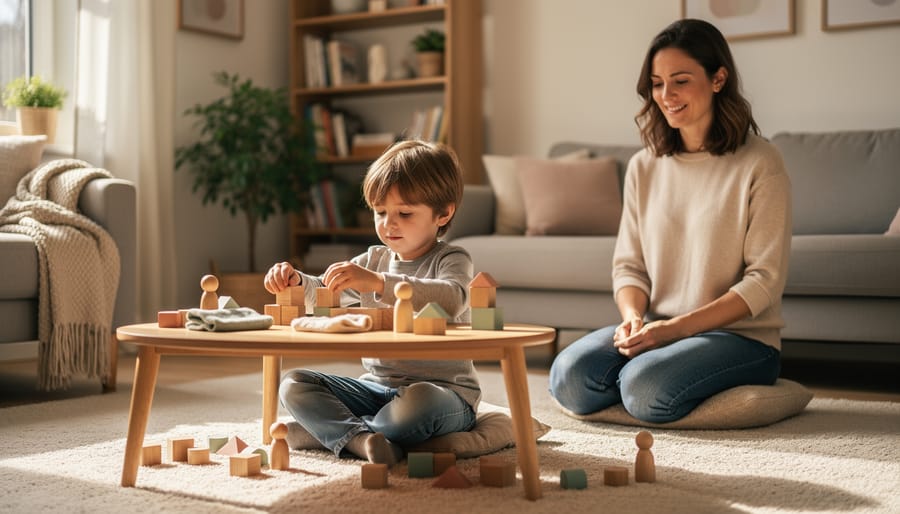
When toddlers first begin role-play stories, they typically work alone. A two-year-old might feed a stuffed bear or put dolls to bed, narrating their own simple scripts without needing an audience. This solitary play lets them practice ideas and language at their own pace, building confidence in their storytelling abilities.
Around age three or four, something shifts. Children start inviting others into their imaginary worlds. “You be the baby, I’ll be the mummy” marks a developmental leap, they’re now coordinating their narrative with someone else’s ideas and actions. This collaborative storytelling requires new skills: explaining the scenario, assigning roles, and adjusting the plot when a playmate suggests something unexpected.
These negotiations can be surprisingly complex. Two children might spend ten minutes debating whether the spaceship lands on Mars or the Moon, or who gets to be the superhero versus the sidekick. They’re learning to compromise, take turns with preferred roles, and merge different creative visions into one shared story. When adults join in, they model listening, following the child’s lead, and adding ideas without dominating the narrative. This back-and-forth strengthens social flexibility and teaches children that stories grow richer when built together.
Different Forms Role-Play Stories Take
Everyday Life Stories
Children instinctively recreate the world they see around them. A toddler stirs an empty pot with intense concentration, mimicking dinner preparation. A four-year-old lines up stuffed animals and scolds them gently, rehearsing what a parent might say at bedtime. These everyday life stories, playing house, pretending to shop, caring for baby dolls, form the foundation of role-play.
Through these familiar scenarios, children make sense of routines that adults take for granted. When your child pretends to cook breakfast or pay at a checkout, they’re practicing sequences, cause and effect, and social expectations. Who speaks first at the doctor’s office? What happens after you put on pajamas?
This type of play also helps children feel competent and in control. By taking the adult role, they experience agency. They become the one who knows what to do, reversing the daily reality of being guided and corrected. That sense of mastery builds confidence and helps them navigate real-world situations with less anxiety.
Fantasy and Adventure Stories
Dragons lurk behind the sofa. Superheroes zoom through the hallway. A cardboard box becomes a rocket ship bound for distant planets. Fantasy and adventure role-play stories let children step into worlds where anything’s possible.
These imaginative scenarios serve a deeper purpose than entertainment. When your child battles a pretend monster or rescues a captured princess, they’re experimenting with concepts like courage, vulnerability, and control. A shy child might roar as a dinosaur, testing what it feels like to be powerful. An anxious child might defeat the “scary thing under the bed” in play, gradually building confidence to face real fears.
Fantasy play also lets children rehearse big emotions in a safe container. The superhero who saves the day practices agency and problem-solving. The space explorer venturing into unknown territory learns to manage uncertainty. Through these adventures, children discover they can be brave, resourceful, and capable, lessons that transfer into everyday challenges like trying new foods, making friends, or sleeping in their own bed.
Emotional Processing Stories
Children often create role-play stories that mirror situations causing them stress or confusion. You might notice your child repeatedly acting out going to the doctor’s office after a vaccine appointment, or playing “first day of school” dozens of times before the actual event. These rehearsals aren’t random, they’re purposeful emotional work.
When children replay difficult experiences through story, they gain distance and control. The child who was scared becomes the doctor giving the shots. The worried kindergartner becomes the confident teacher. This perspective shift helps them understand what happened and reduces anxiety about future encounters.
Sibling conflicts, parental arguments, moving house, or losing a pet frequently surface in role-play narratives. A child might create elaborate stories where stuffed animals fight and make up, or where toy families say goodbye and reunite. Through these scenarios, children practice emotional vocabulary, test different outcomes, and gradually integrate difficult feelings.
This type of play serves a genuinely therapeutic function. Rather than interrupting or redirecting these stories, give them space. Your child is processing big emotions in the healthiest way they know how, through the safe container of pretend play.
How Children Use Role-Play Stories in Real Life
Building Social and Emotional Skills
When a four-year-old insists her teddy is sad because nobody listened to his ideas, she’s doing more than playing, she’s practicing empathy. Role-play stories create a low-stakes laboratory where children experiment with understanding others’ feelings and viewpoints.
Taking on different characters forces children to think from someone else’s perspective. The child playing the baby experiences being cared for; the one playing the parent practices nurturing. This back-and-forth builds the foundation for genuine empathy as children imagine what others might feel or need.
These stories also demand cooperation and negotiation. Watch two children argue over who gets to be the superhero, then compromise by creating two heroes with different powers. They’re learning to balance their desires with group harmony, a skill that transfers directly to friendships and classroom dynamics.
The emotional vocabulary children develop through role-play is remarkable. Instead of just feeling angry, they express it through a character, “My dragon is furious because someone stole his treasure.” This distance makes feelings safer to explore and helps children build the language to identify and communicate emotions in their real lives.
Supporting Language and Cognitive Growth
Role-play stories create a natural laboratory for language learning. When your four-year-old announces, “I’m the veterinarian and this puppy needs an injection,” she’s practicing specialized vocabulary in context, words she might not use in everyday conversation. Children experiment with new terms, test out complex sentence structures, and learn that different characters speak differently. The shy prince talks softly while the roaring dragon uses bold exclamations.
This narrative play strengthens cognitive skills beyond language. Sequencing develops as children organize events: first the patient arrives, then the examination happens, finally the treatment works. They practice cause-and-effect reasoning and build working memory by holding multiple plot threads simultaneously. When a child remembers that yesterday’s pretend pet shop ran out of hamsters and continues that storyline today, she’s exercising executive function, planning, remembering, and adjusting her story.
The same skills that emerge through learning gamification flourish in role-play stories: problem-solving, flexible thinking, and sustained attention. The difference is that children drive the narrative entirely, making the cognitive workout feel like pure play rather than structured activity.
Processing Experiences and Emotions
Children naturally turn to role-play stories when they need to make sense of experiences that feel too big to understand all at once. A four-year-old might replay her visit to the hospital over and over, casting her teddy bear as the patient and herself as the kind doctor. Through repetition and control, she decides when the shot happens, how much it hurts, what the doctor says, she transforms a frightening memory into something manageable.
This rehearsal isn’t avoidance. It’s active processing. When a child acts out the first day of school with his action figures, he’s exploring his anxieties from a safe distance. He can pause the story, rewrite the ending, or give his character the brave words he couldn’t find in the moment. The emotional weight lessens with each retelling.
Role-play also lets children test reactions without real-world consequences. A child worried about her parents arguing might stage a fight between dolls, then orchestrate a gentle reconciliation. She’s working through possibilities, practicing emotional regulation, and building a mental toolkit for coping.
This is why seemingly dark or repetitive play often signals health, not distress, it means the child trusts play as their workshop for feelings.
How Parents and Caregivers Can Support Role-Play Stories
Creating Space and Time for Play
Children need three essential ingredients for role-play stories to flourish: time, space, and freedom from interruption.
Unstructured time matters most. Aim for at least 30-60 minutes of daily play without adult direction or scheduled activities. Rich narratives don’t emerge in rushed 15-minute windows between commitments. Children need time to develop characters, build worlds, and lose themselves in the story. Boredom often precedes the best imaginative play, resist filling every moment.
Physical space doesn’t need to be elaborate. A corner with cushions, a cardboard box, or even just floor space works. What matters is consistency and accessibility. When children know their block city will stay intact or their dress-up clothes are within reach, they invest more deeply in ongoing narratives.
Digital distractions fragment attention. Background television, notifications, and screens competing for focus pull children out of the focused state role-play requires. Create tech-free zones and times. The quiet that feels uncomfortable to adults often signals a child’s mind actively constructing imaginary worlds.
When to Worry (and When Not To)
Most role-play stories, even intense or repetitive ones, fall well within the range of healthy development. A child who pretends to be a monster every day for weeks isn’t cause for concern. Neither is a four-year-old who insists on being called by their character’s name at dinner. These patterns show deep engagement, not dysfunction.
What’s worth noticing: play that feels stuck rather than evolving. If your eight-year-old can’t separate fantasy from reality when asked directly, or if their stories always center on graphic violence without resolution or emotional range, mention it to your pediatrician. Similarly, a child who used to play imaginatively but now avoids all pretend play and peers might be signaling withdrawal that deserves attention.
Context matters enormously. A child processing a recent frightening experience through repeated role-play is doing healthy work. The same themes appearing for months without shifting, or interfering with school and friendships, warrant a conversation with a professional.
Trust your gut. You know your child’s baseline. Significant changes in play, or persistent themes that worry you, are worth discussing, even if just for reassurance.
Real Stories: Role-Play in Action
Maya, a preschool teacher in Toronto, noticed four-year-old Liam struggled with transitions between activities. One afternoon, she watched him transform the reading corner into a “spaceship command center,” recruiting two classmates as crew members. He narrated their mission to “save the dinosaurs from the meteor,” assigning each friend a critical role. What struck Maya most was how Liam naturally built a countdown into his story, giving himself and his peers a structured way to move from one activity to the next. “He was teaching himself time management through play,” she reflects. “That narrative framework gave him control he couldn’t find in our regular routine.”
Parent Sarah shares a different insight from her six-year-old daughter Emma’s hospital play. After a younger sibling’s surgery, Emma spent weeks playing “doctor and sick baby,” switching between roles. Sometimes she was the brave patient, other times the reassuring surgeon. “I realized she wasn’t just copying what she’d seen, she was trying on different perspectives to make sense of her fear and helplessness,” Sarah explains. The stories grew more detailed and less anxious over time, eventually incorporating imaginary tools and happy endings.
Third-grade teacher James observed how digital experiences shape modern role-play when students began weaving library VR programs into their playground narratives. After a class visit exploring underwater ecosystems, the monkey bars became a submarine for weeks. “They took that fifteen-minute virtual experience and expanded it into this whole collaborative world with shifting plots and character development,” he notes. “Technology sparked the imagination, but the real learning happened in the unscripted play afterward.”
Common Questions About Role-Play Stories
Parents often find themselves puzzled or even worried when watching their children dive into elaborate role-play worlds. Some themes seem repetitive, others surprisingly dark, and the whole experience can raise questions about what’s typical and what deserves attention. Here are answers to the concerns we hear most often.
Is it normal for my child to play the same story over and over?
Absolutely. Repetition helps children master concepts, work through emotions, and feel a sense of control. If a child replays a doctor visit or separation scenario dozens of times, they’re processing something meaningful, not stuck in unhealthy patterns.
Should I be concerned about violent or scary themes?
Most children explore power, danger, and conflict through play without it reflecting real aggression or trauma. Watch for context: if the play includes resolution, turn-taking, and your child can stop when asked, it’s likely healthy exploration. Persistent themes with no narrative closure or play that feels compulsive may warrant a conversation with a pediatrician.
What if my child prefers solo role-play to playing with others?
Many children need alone time to develop their ideas before sharing them, and some temperaments naturally lean toward independent play. As long as your child can engage socially when needed and shows interest in others, solo storytelling is perfectly normal and valuable.
Can role-play stories help shy or anxious children?
Yes. Role-play offers a low-pressure way to practice social scenarios, rehearse difficult conversations, and build confidence. Playing out challenges in a safe space can support mental health by giving children tools to manage worry and develop coping strategies.
Gender-stereotyped roles also spark questions. If your daughter only wants to play princess or your son insists on being the superhero, it doesn’t mean you’ve failed at raising an egalitarian child. Kids experiment with cultural scripts they observe, and restricting their choices can backfire. Offer diverse options without judgment, model varied roles yourself, and trust that exploration is part of figuring out identity.
Screen time’s impact on role-play is real but nuanced. Passive watching doesn’t build the same skills as active storytelling, but shows and games can inspire rich narratives if children use them as launching pads rather than scripts to follow verbatim. Balance matters more than elimination.
The presence of imaginary friends puzzles some parents, but these companions are common and cognitively sophisticated. A child who can create and sustain an invisible character demonstrates advanced abstract thinking and emotional intelligence. Imaginary friends typically fade naturally as peer relationships deepen.
Role-play stories aren’t just entertainment, they’re essential developmental work. When your child transforms the living room into a spaceship or acts out a trip to the grocery store, they’re actively building the neural pathways that support emotional regulation, social understanding, and creative problem-solving. This imaginative play strengthens resilience and helps children make sense of their world in ways that direct instruction simply can’t replicate.
As you think about your child’s overall play patterns, it’s worth considering how different experiences shape development. Just as traditional role-play nourishes growth, understanding VR and play or the screen time impact helps you create a balanced environment for learning.
Trust your child’s natural capacity for growth through play. Your role isn’t to direct every scenario or teach explicit lessons, it’s to provide time, space, and gentle support. The stories they create today are building the mental health and social competence they’ll carry into tomorrow.