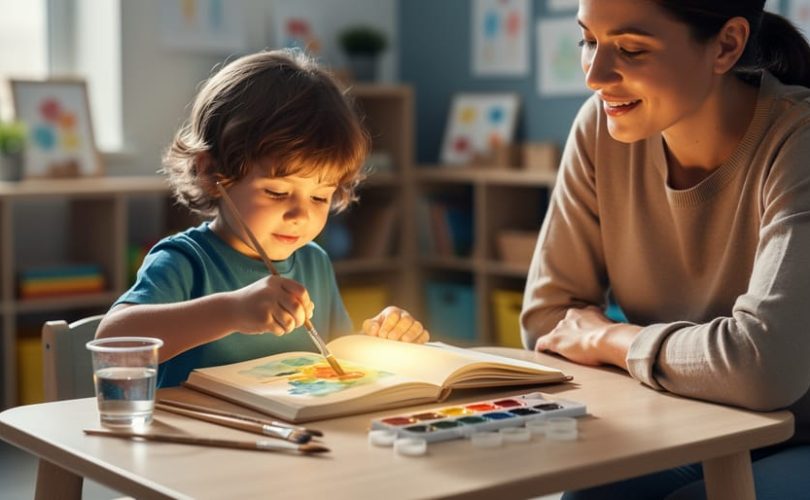
Creativity and mindfulness are two powerful mental practices that, when combined, help children develop emotional regulation, problem-solving skills, and resilience. Creativity involves expressing thoughts and feelings through activities like drawing, storytelling, or music, while mindfulness teaches kids to focus on the present moment without judgment. Together, they create a unique pathway for children to process emotions, reduce anxiety, and build confidence in ways that feel natural and engaging rather than clinical or forced.
Parents and teachers searching for ways to support children’s mental health often feel overwhelmed by complicated interventions or worry they lack the expertise to help effectively. The good news? You don’t need special training to introduce these practices. When a child paints what they’re feeling or takes three deep breaths before tackling homework, they’re already using creativity and mindfulness as tools for emotional well-being.
Research consistently shows that creative activities activate different brain regions than traditional talk-based approaches, making them especially valuable for younger children who struggle to verbalize complex emotions. A seven-year-old might not be able to explain why they’re anxious about school, but they can draw it. That act of creation, paired with mindful attention to the process rather than the outcome, becomes both expression and regulation at once.
This article will walk you through how creativity and mindfulness work together in the developing brain, the different ways children naturally use these skills, and practical starting points for incorporating them at home or in the classroom. You’ll find concrete examples that respect your child’s individual interests and developmental stage, along with guidance on recognizing when these approaches are helping and when additional support might be needed. The goal is simple: give you confidence to try these evidence-based practices in everyday moments.
What Creativity and Mindfulness Mean for Children
When we talk about creativity and mindfulness with children, we’re not describing lofty artistic pursuits or hour-long meditation sessions. We’re talking about two deeply human capacities that every child already possesses, they just need space and encouragement to use them.
Creativity for children means the freedom to explore, experiment, and make something their own. It shows up when a five-year-old builds an elaborate city from couch cushions, when a ten-year-old invents a new game at recess, or when a teenager writes song lyrics in a notebook. It’s problem-solving, imagination, and the confidence to try something without knowing exactly how it will turn out. Unlike adult creativity, which often carries pressure to produce something impressive or original, children’s creativity thrives on curiosity and play. It doesn’t need to result in a masterpiece. The value lies in the doing.
Mindfulness, for kids, is simpler than the formal practice many adults imagine. It’s the ability to notice what’s happening right now, how their body feels, what they’re thinking, what’s around them, without immediately judging it or rushing past it. A child practicing mindfulness might focus on the cool texture of clay in their hands, notice their breath slowing down during a quiet activity, or simply pay full attention to the colors they’re choosing for a drawing. It’s awareness without agenda.
- Creativity
- The ability to explore ideas, express yourself, and make something new in your own way. For children, it’s about the process of trying, not the perfection of the result.
- Mindfulness
- Paying attention to the present moment with openness and without judgment. It’s noticing what you’re feeling, thinking, or sensing right now.
- Self-expression
- Sharing your thoughts, feelings, or ideas in a way that feels true to you, whether through words, art, movement, or play.
- Present-moment awareness
- Being fully here, noticing what’s happening now rather than worrying about what’s next or dwelling on what’s already passed.
- Creative flow
- That absorbed state when a child is so engaged in an activity that time seems to disappear and everything else fades into the background.
These concepts matter for development because they help children build emotional literacy, manage stress, and develop a sense of who they are. Creativity gives kids a language beyond words to express what’s inside them. Mindfulness teaches them to pause, notice, and respond rather than react. Together, they create a foundation for resilience that serves children long after childhood ends.
How Creativity and Mindfulness Work Together
The Calm-Create Cycle
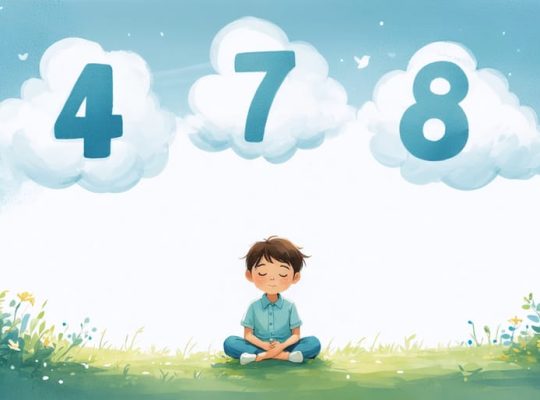
When a child’s mind is racing with worry or overwhelmed by big feelings, there’s little room left for imagination. Anxiety fills up mental bandwidth, it keeps the brain on high alert, scanning for problems, replaying mistakes, or bracing for what might go wrong. Mindfulness practices gently interrupt that loop. Simple techniques like 4-7-8 breathing or a quick body scan help a child’s nervous system downshift from fight-or-flight into a calmer, more open state. The chatter quiets. The shoulders drop. Suddenly, there’s space.
That space is where creativity lives. When children feel safe and present, their brains can wander in productive ways. They notice details they’d normally miss. They make unexpected connections. They take small risks, trying a new color combination, inventing a story twist, building something just to see what happens. Mindfulness doesn’t force creativity; it clears the path for it.
This isn’t magic, it’s neuroscience. The same prefrontal cortex that helps with focus and emotional regulation also supports flexible thinking and problem-solving. When we help kids calm their stress response, we’re literally freeing up brain resources for creative exploration. The calm-create cycle becomes self-reinforcing: mindfulness opens the door, creativity walks through, and the act of creating brings more presence and calm.
Why Creative Activities Are Naturally Mindful
When children paint, build with blocks, or strum a ukulele, something interesting happens: they stop thinking about yesterday’s playground argument or tomorrow’s spelling test. They’re just there, absorbed in the texture of clay or the pattern of colors mixing on paper. This is mindfulness happening naturally, without anyone needing to explain what “being present” means.
Creative activities demand attention in a gentle way. A child threading beads has to focus on the hole, the string, the rhythm. A child making up a song listens to the sounds they’re creating and adjusts. Unlike homework or chores, creative play doesn’t feel like work, so children willingly give it their full attention. They enter what psychologists call a flow state, that feeling of being completely engaged where time seems to disappear.
The sensory nature of creative work anchors children in their bodies and the immediate moment. The squish of playdough, the scratch of crayons, the weight of a paintbrush, these physical sensations pull awareness into the here and now, which is the essence of mindfulness. There’s no right or wrong way to do it, which removes the anxious mental chatter about performance. The process itself becomes calming.
This is why creative activities work so well for children who find traditional meditation difficult or boring. They’re practicing the same skill, paying attention to the present, but through doing rather than sitting still.
Different Ways Kids Practice Mindful Creativity
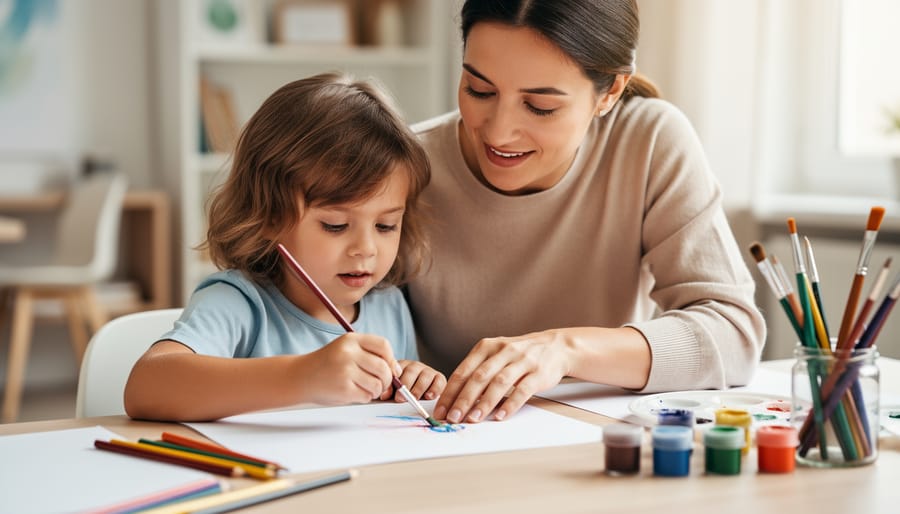
There’s no single “right” way for children to blend creativity and mindfulness, what matters is finding activities that feel natural and engaging for each individual child. Some kids light up with paints and paper, while others find their flow through movement, sound, or hands-on materials. The beauty of this approach is its flexibility: you can meet children where they are and adapt to their interests, energy levels, and developmental stage.
Here are some of the most accessible and effective ways kids practice mindful creativity:
- Mindful drawing and coloring: Simple mark-making, doodling, or coloring mandalas where the focus is on the sensation of pencil on paper rather than making something “good”
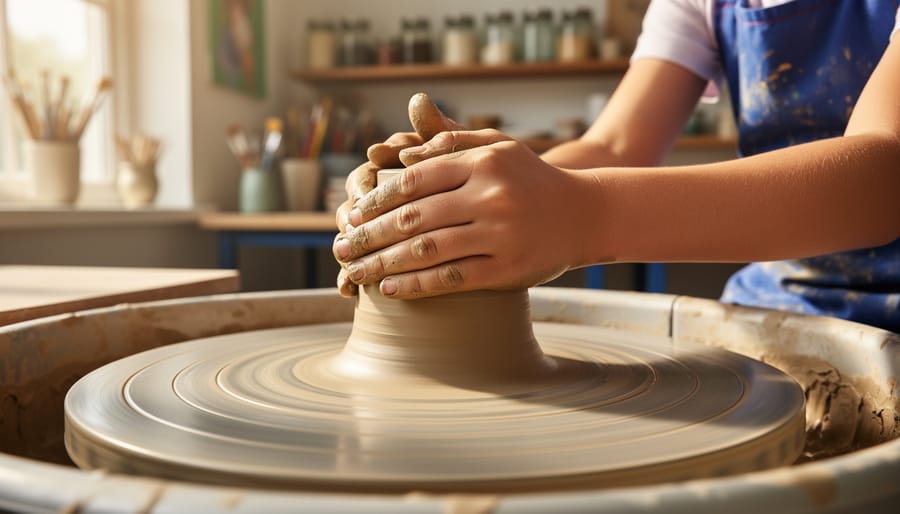
- Clay and sensory art: Working with playdough, clay, or sand, materials that invite touch, manipulation, and experimentation without pressure to create a finished product
- Music and sound exploration: Playing simple instruments, humming, tapping rhythms, or just listening deeply to sounds in the environment
- Movement and dance: Free-form movement, stretching, or improvised dance that connects body awareness with creative expression
- Nature crafts: Collecting leaves, arranging stones, building stick structures, or creating land art that combines outdoor time with artistic play
- Storytelling and journaling: Inventing stories, drawing picture journals, or dictating tales that reflect inner experiences and imagination
- Photography and observation: Taking photos of interesting details, light, or textures, training attention on the visual world with curiosity rather than judgment
What ties these activities together isn’t the medium but the mindset. When a child is absorbed in shaping clay, they’re noticing texture, temperature, and resistance. When they’re arranging leaves by color, they’re practicing attention and making intentional choices. When they’re inventing a story about a brave character, they’re processing emotions through narrative. Each activity becomes mindful when the child is present with it, engaged in the process rather than racing toward an outcome.
Mindful storytelling for instance, invites children to slow down and notice the details of their imagined worlds, what does the character see, hear, or feel in this moment? It shifts storytelling from performance to exploration, which can be especially powerful for children who struggle to name their emotions directly.
The key is offering variety without overwhelming choice. You might introduce one or two options at a time, observe what captures your child’s attention, and let their interest guide you. Some children return to the same activity repeatedly, finding comfort in repetition. Others prefer to sample widely. Both approaches are valid. The goal isn’t to master every form of creative expression but to discover which ones help that particular child feel calm, curious, and connected to themselves.
How Mindful Art and Creativity Help with Self-Expression
Giving Feelings a Shape
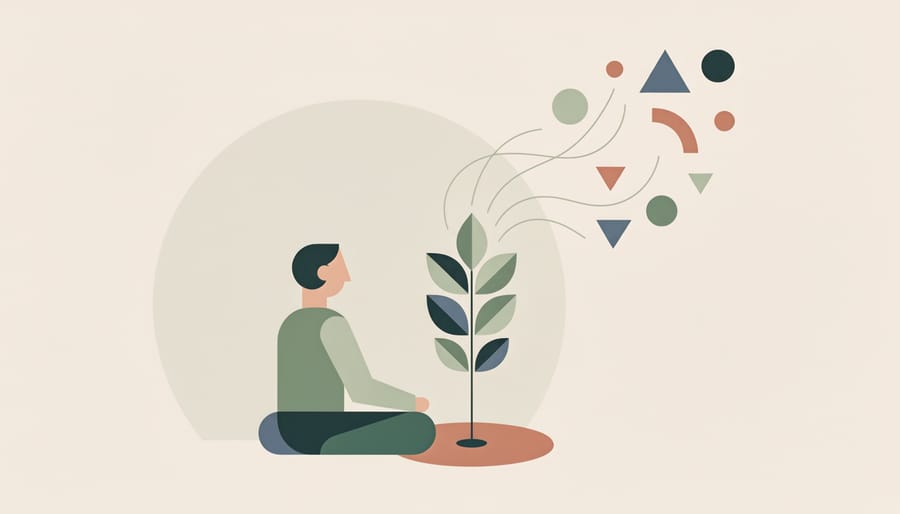
When a seven-year-old can’t explain why they feel scared at bedtime, or a ten-year-old shuts down instead of talking about friendship troubles, creative activities offer another language. Drawing, painting, sculpting with clay, or building with blocks lets children give their feelings a physical form they can see and touch. A tangled scribble becomes anger. A soft watercolor becomes sadness. The act of creating something transforms an overwhelming internal experience into something manageable outside their body.
This externalization matters because children often lack the vocabulary for what they’re feeling. They know something hurts or feels wrong, but naming it, much less explaining it, is beyond their developmental reach. When a child paints a storm cloud, they’re not just making art. They’re saying “this is how it feels inside me right now” without needing to find the precise words. That visual or tactile representation becomes a bridge between their inner world and the adults trying to help them.
Creative activities also help children process big emotions by providing distance. Once a feeling exists on paper or in clay, a child can look at it, talk about it with a parent or teacher, even change it. They can add sunshine to the storm, cover the angry scribble with calm blue, or reshape the clay into something new. That control, the ability to transform something that felt impossible to handle, builds emotional understanding and agency. Over time, children learn that feelings are temporary, changeable, and survivable, not permanent states they’re trapped inside.
Building Confidence and Identity
Every time a child chooses a color, invents a character, or decides how their creation should look, they’re making a small declaration: This is what I think. This matters to me. These choices, repeated over time, build something essential, a sense of self that isn’t dependent on grades, performance, or approval from others.
Creative activities give children a space where there are no wrong answers. A painting doesn’t have to look like anyone else’s. A story can unfold however they imagine it. This freedom teaches them that their perspective has value, that their ideas deserve to exist in the world. For children who struggle academically or socially, this can be profoundly affirming. They discover competencies that don’t show up on report cards.
Mindful creativity also builds resilience by giving children practice with uncertainty and imperfection. When paint drips unexpectedly or clay cracks, they learn to adapt rather than abandon the project. They experience the satisfaction of problem-solving on their own terms, which strengthens their belief in their ability to handle challenges.
Over time, this accumulates into a sturdier self-concept. Children who regularly engage in creative self-expression tend to develop a clearer sense of who they are, their preferences, strengths, and emotional landscape. They’re building an internal anchor that helps them navigate peer pressure, change, and self-doubt. The confidence doesn’t come from being good at art. It comes from the practice of honoring their own voice.
Getting Started: Simple Ways to Bring It Home or Into the Classroom

Starting a mindful creativity practice with children doesn’t require special training or expensive materials. It begins with creating a space where kids feel safe to explore without judgment.
Create a Low-Pressure Environment
Set up a corner or table where art supplies stay accessible. Keep materials simple: paper, crayons, clay, or even just sticks and leaves from outside. The goal isn’t a stocked art studio but a place that says “you can create here whenever you want.” Remove clocks and timers from the space if possible. When children know they won’t be rushed, they settle into the present moment more naturally.
Most importantly, resist the urge to display or praise every creation. Comments like “that’s so beautiful” or “what is it?” can shift a child’s focus from the experience to the product. Instead, try “I noticed you spent a long time on those colors” or “you seemed really focused just now.” This keeps attention on the process and their internal experience.
Model the Practice Yourself
Children learn mindfulness by watching adults engage with it authentically. Sit down with your own paper and draw alongside them. Narrate your experience occasionally: “I’m noticing how the crayon feels bumpy on this texture” or “I’m going to take a breath and start again.” When you mess up or feel frustrated, say it out loud and show them how you return to calm.
You don’t need to meditate formally first. Simply being present, setting your phone aside, and genuinely engaging with materials teaches mindfulness more effectively than any script.
Let Them Lead the Pace
Some children dive in immediately. Others need weeks of watching before they touch a paintbrush. Both responses are normal. A child who only scribbles for two minutes got what they needed in that moment. Another might spend an hour arranging rocks in patterns. Your job isn’t to extend or redirect their engagement but to protect the space and time for whatever emerges.
For classroom settings, consider offering mindful creativity as a choice during transitions or free periods rather than a mandatory activity. When it’s optional, children approach it with curiosity instead of obligation, which is when the real benefits unfold.
Common Questions Parents Ask About Creativity and Mindfulness
Parents often have thoughtful questions when they first hear about using creativity and mindfulness with their children. These concerns are natural, especially when you’re trying something new or wondering whether it will actually help your child. Here are the questions that come up most often.
Is this the same as art therapy?
Not quite. Art therapy is a formal mental health treatment led by a trained therapist who uses creative activities to address specific psychological goals. What we’re talking about here is mindful creativity that any parent or teacher can facilitate, simple, accessible practices that support emotional wellbeing without requiring clinical training.
What age should we start?
Even toddlers benefit from creative play and simple present-moment activities like finger painting or playdough squishing. You can introduce mindful breathing and more structured mindfulness concepts around age four or five, adapting the approach to match your child’s developmental stage and attention span.
What if my child doesn’t like art or says it’s boring?
Creativity isn’t just drawing and painting. Try music, storytelling, building with blocks, nature collecting, or even cooking together. The key is finding what genuinely interests your child and approaching it with curiosity rather than performance pressure. Some children need movement-based creativity like dance or dramatic play.
Does this work for kids with ADHD or anxiety?
Yes, often especially well. Children with ADHD often thrive with hands-on creative activities that channel their energy, while anxious children benefit from the calming, predictable rhythm of creative tasks. You may need to adjust session length, offer more structure, or incorporate movement, but the core principles remain effective.
How can I tell if it’s actually helping?
Look for subtle shifts rather than dramatic changes. Your child might handle frustration a bit better, express feelings more readily, seem calmer after creative time, or voluntarily return to these activities when stressed. Progress shows up in small moments, like choosing to draw when upset instead of having a meltdown.
Do I need to understand what they’re creating?
No, and trying to interpret or analyze can actually interfere with the process. Your role is to provide the materials, hold the space, and show genuine interest without judgment. The meaning is theirs to discover, and sometimes the act of creating matters more than what the finished piece represents.
Remember that every child responds differently, and what works beautifully for one might need tweaking for another. If your child seems resistant, step back and observe what they naturally gravitate toward. The goal is never to force participation but to make these tools available when they’re ready. Trust that you know your child best, and give yourself permission to experiment until you find the approach that fits your family.
Creativity and mindfulness aren’t complicated interventions that require special training or expensive materials. They’re already woven into how children naturally explore the world, through drawing, building, humming, moving, even fidgeting to stay calm. What matters most is creating space for these moments and trusting that the process itself holds value, regardless of what gets produced.
You don’t need to become an art therapist or meditation teacher to support your child’s emotional well-being through creative expression. Starting small, a box of crayons and ten quiet minutes, a playlist and permission to move freely, a question like “What does that feeling look like?”, can open doors you didn’t know were there. Some days will feel magical. Others might seem ordinary. Both matter.
Every child has a voice that deserves to be heard, even when words feel impossible. By honoring their unique way of expressing what’s inside, messy, quiet, bold, or barely visible, you’re doing more than supporting mental health. You’re telling them their inner world matters, that there’s no shame in struggling, and that they don’t have to face hard feelings alone.
That’s the work that changes everything.