

Preventing cyberbullying requires a proactive approach that combines consistent communication, environmental safeguards, and skill-building before harmful situations escalate. Rather than waiting to respond to incidents, the most effective prevention strategies focus on creating digital safety structures early, teaching children to recognize harmful behavior patterns, and building home and school environments where young people feel comfortable reporting concerns.
For parents and educators, this means moving beyond basic “don’t talk to strangers” warnings. Children today navigate complex social platforms where harassment can happen in group chats, through shared images, or via anonymous messaging apps. The good news? Research shows that adult involvement, even in age-appropriate forms that respect privacy, significantly reduces both the likelihood of cyberbullying occurring and its severity when it does.
Teaching digital citizenship from an early age establishes the foundation. When children understand that their online actions have real consequences for real people, they’re less likely to engage in harmful behavior themselves and more equipped to respond when they witness it.
Prevention also requires addressing the uncomfortable reality that any child can be involved in cyberbullying, whether as a target, perpetrator, or bystander. Creating space for honest conversations about what constitutes harmful online behavior, without shame or judgment, helps children develop the critical thinking skills they need to navigate digital spaces safely.
The eight evidence-based strategies outlined here provide concrete starting points for building a comprehensive prevention approach. Each method addresses a different aspect of online safety, from practical privacy measures to fostering empathy and emotional regulation skills that protect children both online and off.
Understanding Why Prevention Matters
Cyberbullying affects children differently than traditional bullying because it follows them home, happens 24/7, and reaches wider audiences instantly. When kids face repeated online cruelty, whether through mean comments, exclusion from group chats, or humiliating posts, it can trigger anxiety, depression, social withdrawal, and declining academic performance. Some children internalize these experiences silently, making the emotional toll harder for parents to recognize until the damage deepens.
Waiting until your child is already targeted puts you in crisis mode, trying to heal wounds while still navigating the immediate threat. Proactive prevention, by contrast, equips children with protective skills and creates guardrails that reduce their vulnerability. It’s similar to teaching water safety before letting kids swim unsupervised rather than learning CPR only after someone nearly drowns. The strategies ahead focus on building this protective foundation now, so you’re not left managing the aftermath of something that might have been avoided entirely.
How We Chose These Prevention Strategies
We selected these eight prevention strategies based on four key criteria that matter most for families navigating online safety.
First, each approach is evidence-informed. We drew from current research in child psychology, digital citizenship programs, and recommendations from mental health professionals who work directly with children affected by cyberbullying. While we avoid citing unverified statistics, these methods reflect what experts in 2026 consider effective prevention.
Second, they’re genuinely actionable. You won’t find vague advice here. Every strategy includes concrete steps parents and educators can start implementing today, regardless of technical expertise.
Third, these methods are age-appropriate and flexible. What works for a third-grader differs from what a high schooler needs. Each strategy adapts across developmental stages.
Finally, we’ve balanced two essential prevention approaches: building children’s internal skills (like empathy and critical thinking) and creating safer external environments (through privacy settings and monitoring). Real prevention requires both. Children need the judgment to navigate online spaces wisely and the protective boundaries that reduce exposure to harm in the first place.
1. Start Open Conversations About Online Life Early

The best defense against cyberbullying starts before your child ever encounters a harmful message. When you create a foundation of open communication about their online experiences, children learn they can come to you with problems instead of hiding them out of fear or shame.
This doesn’t mean interrogating your child about every text or demanding their passwords. Instead, think of these conversations as you would talks about their school day or friendships. Make digital life a normal topic rather than something you only discuss when there’s trouble.
Start these conversations early, even before your child has their own device. Young children can talk about what they see on your phone or tablet. As they grow, your ongoing dialogue evolves naturally with their increasing independence online.
The key is making yourself approachable. When your child shares something about their online world, resist the urge to immediately problem-solve, lecture, or react with alarm. Listen first. Ask curious, nonjudgmental questions that show genuine interest in their perspective.
Try opening conversations with prompts like these:
- What’s the funniest thing you saw online today?
- Who do you like chatting with most, and what do you talk about?
- Have you ever seen someone being mean to someone else online? How did it make you feel?
- What would you do if someone sent you a message that made you uncomfortable?
- Is there anything that happened online recently that confused you or didn’t feel right?
Notice these questions invite sharing rather than testing knowledge or fishing for confessions. Your tone matters as much as your words.
One mother I spoke with made “tech check-ins” part of her family’s Sunday evening routine. Her teenage daughter initially rolled her eyes, but within months she was voluntarily sharing both positive experiences and concerns. When a classmate started spreading rumors about her online, she told her mom immediately rather than suffering in silence.
That’s the goal: building enough trust that your child’s first instinct is to turn to you, not to handle cyberbullying alone.
2. Teach Digital Empathy and Respectful Communication

Helping children recognize there are real people behind every screen name changes how they communicate online. When kids grasp that their words can genuinely hurt someone, they’re less likely to participate in cruelty and more likely to stand up when they see it happening.
Start by making the invisible visible. Talk about specific situations: “When you read that comment about your classmate’s photo, how do you think they felt?” Help your child imagine the person on the receiving end, their facial expression, their emotional reaction, the potential impact on their day. This builds genuine empathy rather than just following rules.
The pause-before-posting principle gives children a practical decision-making tool. Before hitting send, they should ask themselves three questions: Is it true? Is it kind? Is it necessary? If a message fails any of these tests, it stays in drafts. One mother shared how she practiced this with her daughter by reviewing hypothetical posts together, turning it into a judgment-free game that built critical thinking skills.
Model the behavior you want to see. When your child observes you communicating respectfully in emails, texts, and social media comments, even when you disagree with someone, they absorb those patterns. Point out examples of kind online manners when you see them, and discuss what makes them effective.
Try a simple family activity: write anonymous kind messages to each other and discuss how receiving them feels. Then contrast that with how a mean message would land. This concrete emotional comparison makes abstract concepts real for children, especially younger ones who are still developing perspective-taking abilities.
3. Establish Clear, Age-Appropriate Boundaries and Guidelines

Setting clear boundaries around technology use isn’t about controlling your child, it’s about creating a shared understanding of what healthy digital citizenship looks like in your family. When children participate in developing these guidelines rather than simply receiving a list of rules, they’re far more likely to follow them and internalize the values behind them.
Start by sitting down together to create a family technology agreement. This isn’t a lecture; it’s a conversation. Ask your child what they think responsible device use looks like, what concerns they have about staying safe online, and what boundaries would help them feel in control. Their input matters, and you might be surprised by how thoughtful their suggestions are.
Your agreement should cover the essentials: which platforms and apps are appropriate for their age, how much screen time makes sense on school nights versus weekends, where devices get charged at night (hint: not in bedrooms), and what privacy settings need to stay locked down. Include clear expectations about what kind of content is okay to share and view, and what to do if they encounter something troubling.
Consequences matter too, but frame them as natural outcomes rather than punishments. If your teen posts something unkind, the consequence might be taking a break from that platform to reflect on digital empathy, not losing their phone for a month out of anger.
Remember that boundaries need to evolve. What works for a 10-year-old won’t fit a 16-year-old. Plan to revisit your agreement every six months or whenever your child reaches a new developmental milestone. This ongoing dialogue shows respect for their growing maturity while maintaining the safety net they still need.
4. Monitor Thoughtfully Without Invading Privacy

The goal isn’t to catch everything your child does online, it’s to stay connected enough that you notice when something’s wrong and your child knows you’re paying attention.
Start by being transparent. Tell your child you’ll occasionally check in on their digital life, just like you’d ask about their day at school. Explain that you’re not spying, you’re creating safety. Younger children (elementary age) need more direct oversight: sitting nearby while they use devices, knowing their passwords, and reviewing apps together weekly. This isn’t punishment; it’s age-appropriate supervision.
As children enter middle school, shift toward spot-checks rather than constant surveillance. Ask to see their social media feeds or messages periodically, but give advance notice when possible. One parent I know schedules a monthly “digital check-in” where she and her daughter review accounts together, discussing any confusing interactions. This approach teaches responsibility while maintaining oversight.
High schoolers need more autonomy but not complete independence. Focus your monitoring on patterns, mood changes after device use, withdrawn behavior, secretiveness, rather than reading every text. You might review screen time reports, notice which apps consume their attention, or ask open questions about their online friendships.
The key is proportionality. If your teen has given you no reason for concern and demonstrates good judgment, lighter monitoring respects their growing maturity. If you’ve seen warning signs or your child struggles with boundaries, more active involvement is warranted. Trust builds gradually, and oversight should decrease as your child proves they can handle digital spaces responsibly.
5. Build Your Child’s Critical Thinking and Problem-Solving Skills

Children who can think critically about online interactions are better equipped to spot potential problems before they escalate. Teaching your child to pause and assess situations gives them a powerful tool for prevention. Start by explaining that if something feels uncomfortable or confusing online, that feeling is worth paying attention to.
Help your child recognize common warning signs and develop a mental checklist they can use independently:
- Is someone asking me to keep secrets from my parents or share personal vs sensitive information?
- Does this comment or message make me feel bad, scared, or pressured?
- Would I say this to someone’s face, or would I be okay if my family saw it?
- Is this person trying to isolate me from friends or make me doubt myself?
Role-playing builds confidence. Walk through scenarios together: “What would you do if someone posted an embarrassing photo of a classmate?” or “How would you respond if a group chat turned mean?” Practice responses like “I’m not comfortable with this” or “I’m going to step away and talk to an adult.”
Connect these skills to broader digital safety concepts like privacy and security. When children understand data privacy examples and why protecting information matters, they make smarter choices about what they share and who they trust. One parent I spoke with practices “what would you do” conversations during car rides, turning abstract concepts into concrete action plans her daughter can actually use when she needs them.
6. Strengthen Privacy Settings and Digital Security

Strong privacy settings act as a first line of defense against cyberbullying by controlling who can see your child’s posts, photos, and personal information. When profiles are public or loosely protected, it’s easier for bullies to screenshot content, share it without permission, or use personal details in harassment.
Start by reviewing each platform your child uses and switching accounts to private. This means only approved followers can see posts and contact them directly. Walk through the settings together so your child understands what each option does. Disable location tagging on photos, which reveals where your child spends time, and turn off features that suggest their account to strangers.
Teach your child to be selective about friend and follower requests. If they don’t know someone from real life or mutual connections, they shouldn’t accept. Many platforms now offer restricted or limited profiles, which let someone follow without seeing full content, useful for acquaintances or relatives you don’t want to block entirely.
Set a calendar reminder to review privacy settings every few months. Platforms frequently update their interfaces and introduce new features, sometimes resetting preferences or adding options that default to public. Spending 15 minutes quarterly ensures protections stay intact as your child explores new apps and as companies roll out changes.
7. Foster Offline Connections and Emotional Resilience

Children who feel grounded, confident, and connected in the offline world handle online negativity with greater resilience. When your child has strong friendships beyond the screen, they’re less likely to depend entirely on digital validation and can better put online cruelty in perspective.
Encourage face-to-face friendships through regular playdates, sports teams, youth groups, or hobby classes. These real-world connections provide emotional support that doesn’t disappear when a device is switched off. A child who plays soccer after school, attends art classes, or participates in scouting develops identity and self-worth that aren’t tied to likes, comments, or group chat dynamics.
Diverse interests matter too. When children invest time in music, sports, reading, volunteering, or hands-on projects, they build competence and confidence. They learn they’re good at things, and that being excluded from one online group doesn’t define their entire social life. These activities also create natural conversation topics and shared experiences with peers who have similar passions.
At home, create space for emotional processing. Let your child talk about difficult feelings without immediately fixing the problem or minimizing their distress. Teach coping strategies like deep breathing, journaling, physical activity, or talking to a trusted adult when stress builds. Children who can name their emotions and manage them constructively recover faster from online conflicts and are less likely to internalize cruel messages.
Strong offline roots make online storms easier to weather.
8. Partner With Schools and Other Parents
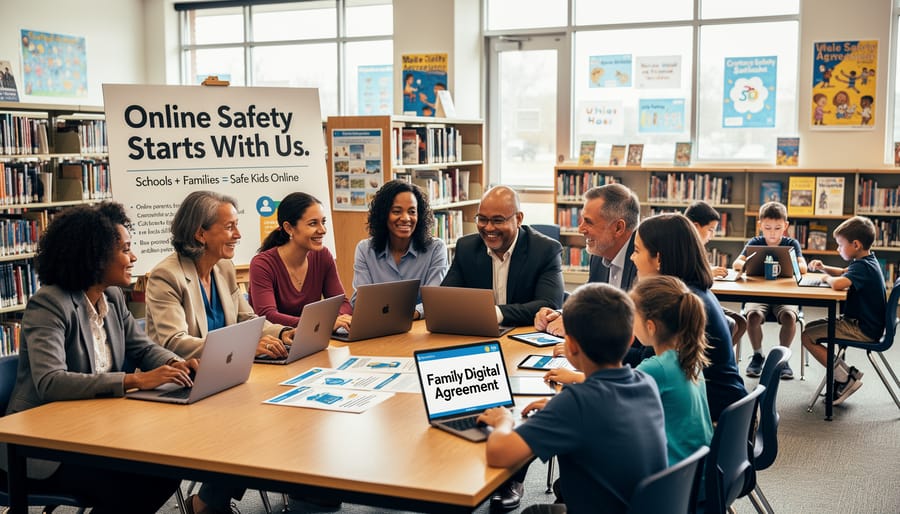
No parent can tackle cyberbullying prevention alone. When schools, families, and communities work together, children benefit from consistent messages and stronger safety nets.
Start by understanding your school’s existing cyberbullying policies. Schedule a conversation with your child’s teacher or school counselor to learn how they address online behavior. If policies seem outdated or unclear, consider joining the PTA or school safety committee to advocate for comprehensive digital citizenship programs. Schools that integrate online safety into their curriculum, not just as a one-time assembly, create lasting change.
Connect with other parents in your child’s grade or activities. A simple group text or coffee meetup lets you discuss shared expectations around social media use, device access, and monitoring approaches. When multiple families adopt similar boundaries, like no phones during sleepovers or consistent platform age requirements, children face less peer pressure to bend the rules.
Look for parent education opportunities in your community. Many schools, libraries, and mental health organizations now offer workshops on digital parenting. These sessions help you stay current on the apps your child uses and teach you warning signs you might otherwise miss.
One mother I know organized quarterly parent gatherings where families shared their evolving tech agreements and supported each other through challenges. The collective knowledge and mutual accountability made every family stronger.
When prevention becomes a community effort rather than an isolated family struggle, children grow up in environments where respectful online behavior is simply the norm.
When Prevention Isn’t Enough: Next Steps
Despite your best prevention efforts, cyberbullying can still happen. This doesn’t mean you’ve failed as a parent, online environments are complex, and children often hide what’s happening until the situation becomes serious.
Watch for warning signs: sudden reluctance to use devices they previously enjoyed, mood changes after being online, withdrawal from friends, unexplained anxiety, changes in sleep or eating patterns, or declining school performance. Some children become secretive about their online activity or delete messages quickly when you’re nearby.
If you suspect cyberbullying, stay calm and approach your child with empathy rather than alarm. Let them know they can tell you anything without judgment. Ask open questions like “You seem upset after using your phone, do you want to talk about what’s happening online?”
Document everything. Take screenshots of harmful messages, posts, or comments with dates and usernames visible. Save evidence before blocking harassers, as platforms and schools may need this documentation. Many platforms have reporting mechanisms, use them.
Contact your child’s school if the bully is a classmate, even if incidents happen outside school hours. Most schools now have cyberbullying policies and can intervene. For severe threats or persistent harassment, consider involving law enforcement.
Remember, responding to cyberbullying doesn’t erase the value of prevention. Every conversation you’ve had and boundary you’ve set has built your child’s resilience and trust in you, resources that matter enormously when challenges arise.
Moving Forward With Confidence
You’ve learned eight evidence-based strategies for preventing cyberbullying, and now comes the most important step: putting them into practice. Start with one or two approaches that feel most relevant to your family’s current situation rather than trying to implement everything at once. Maybe that means having your first open conversation about online experiences this week, or reviewing privacy settings together this weekend.
At what age should I start talking about cyberbullying?
Begin conversations as soon as your child starts using any connected device, typically around ages 5-7, using simple, age-appropriate language. Early prevention is always easier than later intervention.
How do I balance giving my child freedom and keeping them safe?
Balance comes through gradual independence matched to demonstrated responsibility. Start with transparent oversight and clear boundaries, then adjust based on your child’s maturity and judgment over time.
What if my child has already experienced cyberbullying despite my prevention efforts?
Prevention efforts aren’t failures when incidents occur, they’ve built the foundation of trust that allows your child to come to you for help. Use the relationship you’ve created to support them through the situation.
Protecting your child’s mental health online isn’t a one-time task you complete and check off. It’s an ongoing conversation that evolves as they grow, as technology changes, and as new challenges emerge. The effort you invest in prevention today creates lasting benefits: children who communicate openly, think critically about digital interactions, and know they have your support when problems arise. You’re not just preventing cyberbullying, you’re raising digitally resilient young people who can navigate online spaces with confidence and kindness.