A nature outdoor classroom is a dedicated outdoor learning space where children engage with natural materials, seasonal changes, and open-ended play to support academic, physical, and emotional development. These environments range from simple garden patches and shaded gathering areas to fully-equipped forest school sites, all designed to bring curriculum and free exploration into direct contact with the living world.
For parents and educators thinking about children’s mental health in 2026, these classrooms offer something screens and traditional desks cannot: sensory-rich, low-pressure settings where kids regulate emotions through movement, build resilience by taking age-appropriate risks, and develop agency by directing their own learning. A five-year-old balancing on a log practices both gross motor skills and self-confidence. A group of third-graders observing tadpoles learns patience and scientific inquiry without the anxiety that formal testing often brings.
The appeal goes beyond fresh air. Research consistently shows that regular time in nature lowers cortisol, improves attention spans, and reduces symptoms of anxiety and depression in young people. Teachers report calmer classrooms and fewer behavioral issues after outdoor sessions. Parents notice children who seem more curious, more willing to try new things, and better able to manage frustration.
This article will walk you through what nature outdoor classrooms are at their core, how they work in practice, the different models you’ll encounter, and why they’re becoming an essential tool for supporting whole-child well-being. Whether you’re a parent exploring school options or a professional looking for evidence-based strategies, you’ll find clarity on how these spaces translate into real benefits for the children in your care.
What a Nature Outdoor Classroom Really Means
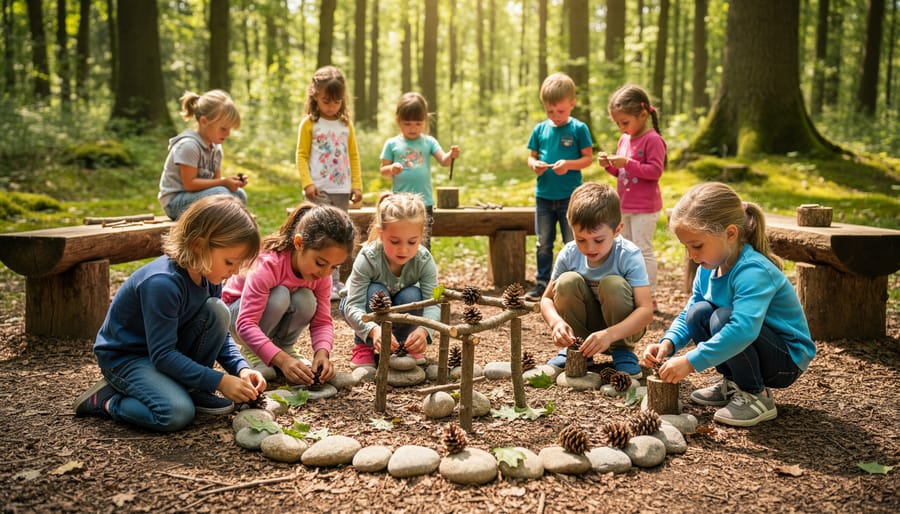
A nature outdoor classroom is a learning environment intentionally placed within or surrounded by natural elements, trees, plants, soil, water, rocks, where children learn through direct interaction with the living world. Unlike traditional playgrounds with fixed equipment or simple recess time, these spaces are designed to invite open-ended exploration, creative problem-solving, and sensory engagement with nature itself.
The core philosophy centers on letting children learn from the environment rather than just being in it. Instead of climbing a manufactured structure, a child might balance on logs, build with fallen branches, or observe how water flows through different types of soil. The natural materials become both the curriculum and the classroom, constantly changing with seasons and weather.
When Sarah first heard about her daughter’s new outdoor classroom at preschool, she pictured muddy chaos. What she found instead was four-year-old Emma carefully arranging pinecones by size, then using them to “write” her name in the dirt. “She was so focused, so proud,” Sarah recalls. “I realized she was doing math, literacy, and art all at once, and she thought it was just play.”
These spaces operate on several key concepts:
- Loose parts
- Natural materials like sticks, stones, leaves, and shells that children can move, combine, and transform in countless ways without prescribed rules.
- Emergent curriculum
- Learning that follows children’s interests and discoveries rather than rigid lesson plans, allowing their natural curiosity to guide exploration.
- Natural play elements
- Living and organic features such as trees for climbing, mud for molding, water for pouring, and plants for observing that change and respond to interaction.
- Place-based learning
- Education rooted in the specific geography, ecology, and seasonal rhythms of a local environment, fostering deep connection to nature.
What makes these classrooms distinct is intentionality. They’re thoughtfully created to maximize learning potential while honoring children’s innate drive to explore, create, and make sense of their world through hands-on experience with nature.
How Nature Outdoor Classrooms Work
The Creative Play Connection
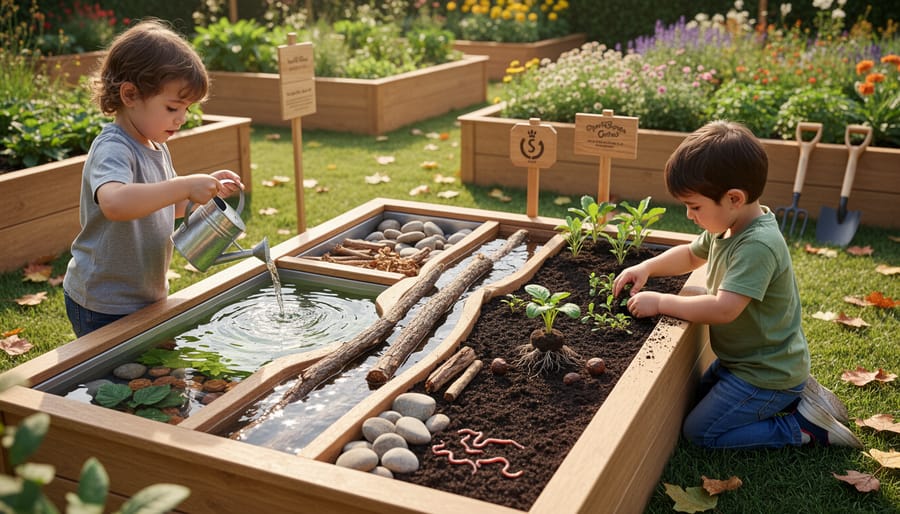
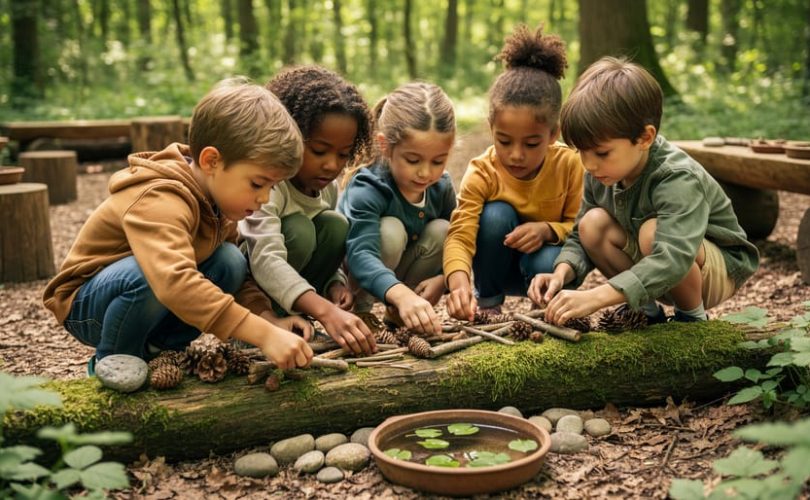
Natural materials invite children into open-ended play that structured toys simply cannot replicate. A stick becomes a magic wand, a fishing rod, or a bridge for imaginary creatures. Mud transforms into cakes, potions, or building mortar. Stones stack into towers or arrange into patterns that tell stories only the child understands. This flexibility allows imaginative scenarios to unfold without preset rules or outcomes, pushing children to generate their own ideas rather than follow instructions.
Research confirms that loose parts foster creativity precisely because they lack fixed functions. In nature classrooms, children encounter problems that demand improvisation: how to dam a stream with rocks, construct shelter from branches, or mix colors using flower petals. These challenges activate divergent thinking, where kids generate multiple solutions rather than searching for one correct answer.
The mental health payoff runs deeper than fun. When children direct their own storytelling play with natural materials, they practice emotional regulation by working through feelings in safe, symbolic ways. The sensory richness of mud squishing between fingers or water flowing over hands calms the nervous system. A child frustrated by school pressures might pound clay-like mud until tension releases, then shape it into something hopeful. These small moments of self-directed creation build resilience, teaching kids they can transform their internal experiences just as they reshape the natural world around them.
Supporting Development Across Domains
Outdoor classrooms don’t isolate skills into separate lessons, they weave cognitive, physical, social, and emotional development together in ways that feel effortless to children but are remarkably powerful.
Cognitively, kids solve real problems: figuring out how to balance stones, estimating distances for stick bridges, or observing patterns in leaves. These tasks build executive function, spatial reasoning, and scientific thinking without worksheets or pressure.
Physically, uneven terrain, climbing, digging, and carrying natural materials strengthen gross and fine motor skills. Children learn their bodies’ capabilities through authentic challenges rather than artificial exercises.
Socially, nature spaces require collaboration. Building a fort demands negotiation, shared roles, and communication. The open-ended environment naturally encourages cooperative play rather than competition over fixed equipment.
Emotionally, outdoor classrooms offer regulation and resilience-building. A child frustrated by a falling structure learns persistence. Quiet moments observing insects provide calming sensory input. The space itself, trees, sky, birdsong, reduces stress hormones while outdoor play increases confidence through mastery of genuine tasks.
This integration mirrors how children naturally learn, making development feel seamless rather than fragmented into isolated domains.
Different Forms Nature Outdoor Classrooms Take
Forest Schools and Woodland Classrooms
Forest schools represent the most established form of nature outdoor classroom, with Forest School began in Scandinavia in the 1950s. These programs bring children into woodland settings weekly or several times per month, regardless of weather. Sessions unfold over months, allowing kids to witness seasonal changes and develop familiarity with specific trees, trails, and natural features.
Children in forest schools engage in open-ended exploration, building shelters with branches, observing insects, balancing on logs, and creating imaginative worlds using only what the forest provides. Trained leaders facilitate safety and learning but follow children’s interests rather than rigid lesson plans. The approach naturally supports art integration as kids craft with natural materials and encourages cooperative games through group projects like fire-building circles.
North American adoption has grown significantly since the early 2000s, with programs now operating in diverse communities from urban parks to rural woodlands.
Schoolyard Nature Gardens
Many schools are reimagining their playgrounds and unused corners as vibrant learning environments. Schoolyard nature gardens replace asphalt and bare ground with native plants, rain gardens, pollinator patches, and small trees that shift with the seasons. These spaces might include raised beds where students grow vegetables, logs arranged for seating circles, rocks for climbing and building, or shallow water features that attract birds and insects.
Unlike traditional playgrounds with fixed equipment, these gardens invite open-ended exploration, children can observe butterflies, collect seeds, dig in soil, or create miniature worlds among the plants. Teachers bring lessons outdoors: reading under a tree canopy, measuring plant growth for math, sketching leaves for art, or discussing ecosystems in science. The garden becomes a living classroom where abstract concepts take root through direct experience.
What makes schoolyard gardens especially valuable is their accessibility. Children don’t need a field trip or special permission, they’re steps from their classroom door, available for brief observations or extended projects throughout the school year.
Backyard Learning Spaces
You don’t need acres of land or expensive equipment to create a nature outdoor classroom at home. A corner of your yard, a patio edge, or even a few large planters can become rich learning environments. Start with what you have: collect fallen branches, stones, pinecones, and leaves in an open basket. Add a small water table or bucket, some old pots and wooden spoons for a mud kitchen, and create a simple digging patch with soil and child-safe tools.
Many parents find that leaving materials loose and unstructured invites the most creative play. A log becomes a balance beam, a boat, a dinosaur, or a shop counter depending on your child’s imagination that day. Plant native flowers or herbs in containers so children can observe growth cycles, attract butterflies, and engage their senses. Even a small magnifying glass and a field guide turn your backyard into a discovery zone. These spaces work because they follow children’s lead rather than dictating how play should unfold.
Community and Park-Based Programs
Community programs bring nature outdoor classrooms to families who don’t have access to yards or forest schools. Many cities now offer structured sessions at local parks, nature centers, and public green spaces, often free or low-cost. These programs might include weekly toddler nature play groups, drop-in forest bathing sessions, or seasonal outdoor exploration classes run by parks departments or nonprofits.
What makes these spaces valuable is their accessibility. A single parent in an apartment can bring their child to a Saturday morning nature program where kids build fairy houses from fallen twigs, explore creek life, or paint with mud. The shared experience also connects families facing similar challenges, reducing isolation while children develop creativity and confidence through unstructured outdoor play in a supportive setting.
How Children and Families Use Outdoor Classrooms
In Educational Settings
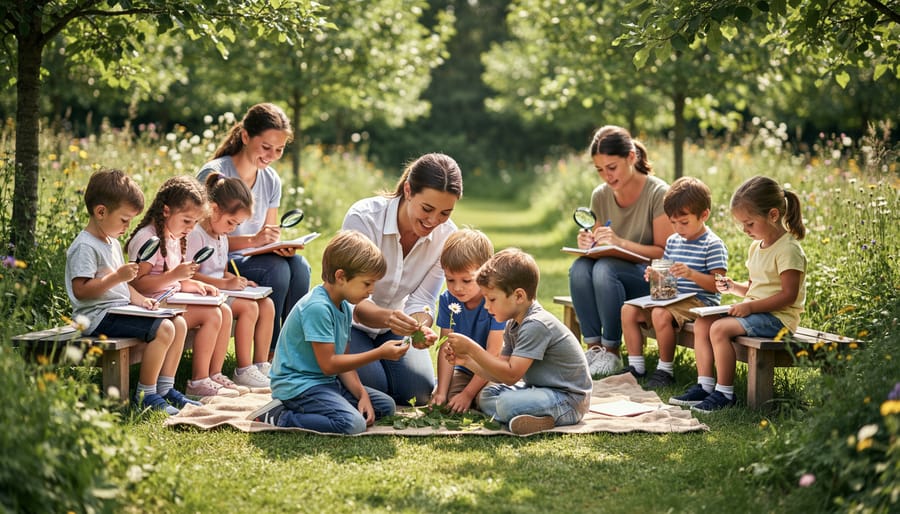
Teachers weave outdoor classrooms into daily learning in surprisingly practical ways. A third-grade class might count tree rings to understand multiplication, or measure shadow lengths to explore angles. Nature journaling has become a staple, children sketch leaves, record weather patterns, and describe bird behavior, building observation skills while processing their day outdoors. Science lessons move from textbooks to direct discovery: students watch pollination happen, track seasonal changes in real time, or investigate decomposition by monitoring a fallen log over weeks.
Storytelling circles under tree canopies create intimate spaces where children share ideas and build narrative skills together. The natural setting reduces social pressure and encourages quieter students to contribute. Dr. Elena Martinez, an educational psychologist who studies outdoor learning environments, notes that “when children collaborate on nature-based challenges, building shelters from branches, creating art from found materials, they develop peer connection and problem-solving abilities simultaneously. The lack of predetermined ‘right answers’ in natural play removes performance anxiety.”
Many teachers report that students who struggle with focus indoors thrive during outdoor classroom sessions. The multisensory environment, wind, birdsong, varied textures, paradoxically helps children concentrate by satisfying their need for sensory input rather than fighting it.
In Therapeutic and Mental Health Support
Therapists, school counselors, and mental health professionals increasingly turn to nature outdoor classrooms as part of treatment plans for children facing anxiety, ADHD, trauma, or difficulties connecting with peers. The natural setting offers what clinical offices often cannot: space to move freely, sensory-rich experiences that ground children in the present moment, and gentle distractions that reduce the pressure of direct eye contact or structured conversation.
Research shows that outdoor classes lowered cortisol levels in children, supporting the body’s stress response system. For a child carrying heavy emotions, building a twig shelter or watching water ripple over stones becomes a safe way to process feelings without words. Natural environments also support emotional co-regulation: a calm adult sitting beside a child under a tree, both engaged in simple observation, creates space for nervous systems to settle together.
These sessions don’t look like traditional therapy. A child with social anxiety might practice asking a peer to help collect leaves, taking small relational risks in a low-stakes context. The outcomes, though, are real and measurable.
In Family and Home Life
You don’t need a dedicated program or school setting to bring outdoor classroom principles home. Start with simple changes to your family’s routine that invite natural exploration and creative play.
Weekend nature play can be as straightforward as designating a corner of your yard or a nearby park as your child’s “discovery zone.” Gather loose parts like pinecones, smooth stones, shells, and fallen branches. Let your child arrange, build, and imagine without directing the activity. One parent described how her daughter spent an entire Saturday afternoon creating a “fairy village” from moss and twigs, narrating elaborate stories as she worked.
Seasonal observation projects help children notice patterns and changes over time. Choose a single tree or garden patch to visit weekly. Take photos, collect leaves, or draw what you see. This gentle rhythm builds curiosity and mindfulness.
A simple mud kitchen, just old pots, wooden spoons, and water near dirt, sparks hours of sensory play. Children mix “potions,” practice measuring and pouring, and work through emotions as they squish and stir.
The key is consistency and permission. Regular outdoor time, even fifteen minutes daily, matters more than elaborate setups. Let your child lead, get messy, and discover at their own pace.
The Mental Health Benefits Parents and Professionals Should Know
When parents and professionals hear about nature outdoor classrooms, the question often surfaces: what exactly do these spaces do for a child’s mental health? The evidence is compelling. Natural environments paired with creative play offer measurable benefits that structured indoor settings simply can’t replicate.
Consider Maria, whose seven-year-old son Leo struggled with persistent worry. After joining a weekly forest school program, she noticed him sleeping better and expressing fewer fears. “It wasn’t instant,” she says, “but watching him build dens and explore on his own terms seemed to quiet something inside him.” Her observation aligns with research showing that time in nature lowers cortisol, the stress hormone, in children’s bodies.
The mental health gains extend across multiple dimensions:
- Reduced anxiety: Natural settings activate the parasympathetic nervous system, calming the body’s fight-or-flight response and easing chronic worry.
- Enhanced executive function: Unstructured outdoor play strengthens attention control, working memory, and impulse regulation, skills often compromised in children with ADHD or trauma histories.
- Improved mood regulation: Sensory-rich environments provide natural outlets for big emotions; digging, splashing, and building help children process feelings without words.
- Increased self-esteem: Mastering real challenges, crossing a stream, identifying a bird, builds genuine confidence that praise alone cannot.
- Stronger peer relationships: Collaborative projects in nature foster cooperation and conflict resolution without adult-imposed structure, teaching social skills organically.
Child psychologist Dr. Rachel Nguyen explains it this way: “When children engage with the living world, they’re not just distracted from their troubles, they’re building the internal resources to face them. Creative play in nature teaches resilience through safe, manageable risk.”
For children carrying trauma, grief, or social anxiety, outdoor classrooms offer what clinicians call a “soft entry point.” There’s no pressure to make eye contact or sit still. A child can work alongside peers without direct interaction, gradually building trust. The absence of walls and rigid expectations removes common triggers, allowing nervous systems to reset. Parents and teachers consistently report that children who struggle indoors often thrive when learning shifts outside, where movement is expected and curiosity is currency.
Common Questions Parents and Educators Ask
Parents and educators interested in nature outdoor classrooms often share similar concerns and questions. These are practical considerations that deserve thoughtful answers, especially when you’re trying to make the best choices for children in your care.
Are nature outdoor classrooms safe for young children?
Yes, when appropriately supervised and with reasonable risk assessment. Natural environments offer age-appropriate challenges that help children develop risk awareness and physical confidence. Most programs establish clear boundaries and teach children to recognize and respect natural hazards like thorny plants or steep slopes.
What about bad weather or extreme temperatures?
The saying “there’s no such thing as bad weather, only bad clothing” holds true for outdoor classrooms. With proper layering, rain gear, and sun protection, children can engage safely in most conditions. Many programs adjust activities seasonally and move indoors during severe weather, lightning, or temperature extremes.
Can children with disabilities or sensory sensitivities participate?
Absolutely. Natural environments often provide calming, flexible spaces that accommodate diverse needs better than traditional classrooms. Many children with ADHD, autism, or anxiety find outdoor settings less overwhelming. Educators can adapt activities, provide quiet zones, and use natural materials at different sensory intensities to support inclusion.
How much time and money does setting up an outdoor classroom require?
You can start small with minimal investment. A backyard learning space might need only a tarp, some containers for collecting natural objects, and access to dirt and water. School programs can begin with one outdoor session weekly using existing grounds. Dedicated forest school programs require more resources, but community and park-based options often charge reasonable fees or offer sliding scales.
Another common worry involves curriculum standards and academic outcomes. Parents sometimes fear outdoor time takes away from “real learning.” Research consistently shows the opposite: children in nature-based programs often meet or exceed academic benchmarks while gaining additional social and emotional skills. The hands-on, experiential learning that happens outdoors deepens understanding in ways that worksheets cannot replicate.
If you’re wondering where to begin, start with what you have. Teachers can take one subject outside each week. Parents can dedicate Saturday mornings to unstructured backyard exploration. You don’t need a forest or specialized training to offer children meaningful contact with the natural world. Even small steps like observing seasonal changes, collecting interesting stones, or building with sticks create opportunities for creative play and the mental health benefits that come with it. The key is consistency and allowing children the freedom to explore, discover, and imagine within natural spaces.
Nature outdoor classrooms offer something children genuinely need: space to explore, imagine, and grow at their own pace. Whether it’s a forest school program, a corner of a schoolyard transformed with native plants, or simply a backyard area with logs and open-ended materials, these environments support creative play in ways that benefit mental and emotional health.
You don’t need a perfect setup or expert knowledge to start. A collection of sticks, a patch of dirt, access to a local park, these small beginnings matter. What counts is giving children regular time in natural spaces where they can lead their own play, take manageable risks, and connect with the living world around them.
For parents wondering if this approach fits their child, remember that nature-based play meets children where they are. It reduces pressure, invites curiosity, and creates room for emotional regulation and social connection without forcing outcomes.
For educators and professionals supporting children’s well-being, outdoor classrooms provide a compassionate tool that complements therapeutic and educational goals. The benefits, lower stress, improved focus, stronger resilience, emerge naturally through play and discovery.
Starting small is enough. A few minutes outside, a weekly walk, or one outdoor activity can open doors. Children’s capacity for joy, creativity, and healing grows when they have the chance to play in nature, and you can help make that happen.