

Emotional intelligence is the ability to recognize, understand, and manage your own emotions while also perceiving and influencing the emotions of others. Unlike fixed personality traits such as introversion or extroversion, emotional intelligence sits in a unique middle ground: it has both trait-like foundations present from early childhood and skill-based components that respond remarkably well to teaching and practice.
This distinction matters deeply to parents and educators. If emotional intelligence were purely a personality trait, you’d be left hoping your child was simply born with it. The research tells a different story. While some children do show natural advantages in reading emotional cues or regulating their responses, studies consistently demonstrate that targeted instruction, modeling, and practice can strengthen these capacities in nearly every child.
Dr. Marc Brackett, director of the Yale Center for Emotional Intelligence, has spent decades documenting how explicit emotional skills training reshapes children’s ability to navigate social situations, cope with setbacks, and build healthier relationships. His work with thousands of schools shows measurable gains even in children who initially struggled with emotional awareness.
The practical question isn’t whether your child has an “EI personality.” It’s whether you and the educators in your child’s life are equipped with strategies to nurture these learnable skills. This article will clarify what emotional intelligence actually encompasses, explain the science behind the trait-versus-skill debate, break down the core components you can strengthen, and connect you with evidence-based approaches that work in both classroom and home settings. Understanding this framework helps you move from worry to action.
What Emotional Intelligence Actually Means
Emotional intelligence is your child’s capacity to recognize, understand, and work with emotions, both their own and those of the people around them. It’s not about being happy all the time or suppressing difficult feelings. Instead, it’s about knowing what you’re feeling, why you’re feeling it, and what to do with that information.
Think of emotional intelligence as an internal navigation system for feelings. When your daughter gets frustrated with a puzzle and takes a break instead of throwing the pieces, that’s EI at work. When your son notices his friend looks sad and asks what’s wrong, he’s using emotional intelligence. These moments reveal capabilities that make a real difference in how children learn, make friends, and handle challenges.
- Perceiving emotions
- The ability to recognize feelings in yourself and read emotional cues in others through facial expressions, body language, and tone of voice.
- Understanding emotions
- Grasping what different emotions mean, how they develop, and how feelings shift and blend into one another.
- Managing emotions
- Regulating your emotional responses in healthy ways, whether that means calming down when upset or motivating yourself when discouraged.
- Using emotions effectively
- Applying emotional information to solve problems, communicate clearly, and make thoughtful decisions.
These four branches form what researchers call the 5 components of EI when broken down further. They work together like instruments in an orchestra, each plays a distinct role, but they create something more powerful when harmonized.
Your child uses these capabilities constantly. When they choose kind words after seeing you’ve had a hard day, they’re perceiving and responding to emotions. When they bounce back after losing a game, they’re managing disappointment. These aren’t extraordinary skills reserved for emotionally gifted children. They’re everyday capacities that every child possesses to some degree and can strengthen with guidance.
Understanding Personality Traits vs. Learned Skills

When you watch your child navigate friendships, handle disappointments, or express joy, you’re seeing both who they naturally are and what they’ve learned along the way. Understanding the difference between personality traits and learned skills helps you support your child more effectively.
Personality traits are the relatively stable patterns of thinking, feeling, and behaving that make your child uniquely themselves. Research shows these characteristics appear early in life and remain fairly consistent over time. Your naturally cautious toddler often becomes a thoughtful teen. These traits have strong biological underpinnings, influenced by genetics and brain structure. They’re the “what you’re born with” part of the equation.
Learned skills, by contrast, develop through practice, experience, and teaching. Your child wasn’t born knowing how to share toys, read facial expressions, or calm themselves when frustrated. These capabilities grow through repeated practice, guidance from caring adults, and real-world experience. Skills are the “what you develop” side.
The nature versus nurture debate has puzzled psychologists for generations because most human characteristics involve both inherited tendencies and environmental influences working together. A child might have a natural inclination toward sensitivity (trait), but how they use that sensitivity to understand others’ feelings develops through experience (skill).
Researchers have debated emotional intelligence’s classification precisely because it straddles this divide. Some aspects of EI look trait-like: stable, measurable early, resistant to change. Other aspects clearly improve with teaching and practice. This complexity explains why you’ll find experts arguing passionately for different positions. The answer matters because it shapes how we help children grow.
How Emotional Intelligence Works in Children
Children’s emotional intelligence develops through an intricate dance of biology and experience. Unlike a pre-programmed trait that simply unfolds, EI builds gradually as young brains mature and children encounter countless emotional moments.
The brain’s emotional circuitry provides the foundation. The amygdala, which processes emotional reactions, is active from infancy, but the prefrontal cortex, responsible for regulating those emotions, develops slowly throughout childhood and adolescence. This explains why your three-year-old can feel overwhelming frustration but can’t yet calm themselves down without help. The neural pathways connecting these regions strengthen with each experience of recognizing, naming, and managing feelings.
Social learning accelerates this development dramatically. Children absorb emotional lessons by watching the adults around them. When a parent takes a deep breath before responding to a stressful situation, the child learns a regulation strategy. When a teacher acknowledges a student’s disappointment and helps them work through it, that models emotional processing. These observations create mental templates that children draw on when facing their own emotional challenges.
Practice genuinely strengthens emotional skills, much like practicing scales improves piano playing. Each time a child identifies what they’re feeling, considers someone else’s perspective, or chooses a helpful response over an impulsive one, they reinforce those neural pathways. Repetition makes emotional skills more automatic and accessible.
Developmental milestones mark this progression:
- Toddlers (ages 2-3) begin naming basic emotions and showing early empathy when others are upset
- Preschoolers (ages 4-5) develop better emotional vocabulary and start understanding that others may feel differently than they do
- Early elementary (ages 6-8) gain basic self-regulation strategies and can recognize emotions in facial expressions and body language
- Middle childhood (ages 9-11) show more sophisticated perspective-taking and can manage complex social situations
- Adolescents refine abstract emotional understanding and integrate emotional information into decision-making, though brain development continues into their twenties
This developmental arc matters for parents and educators because it reveals what’s realistic to expect at each age. A five-year-old struggling to share isn’t emotionally deficient; their brain simply hasn’t developed the full capacity for impulse control and perspective-taking yet. Understanding this timeline helps adults provide age-appropriate support rather than expecting skills that haven’t emerged yet, while still creating opportunities for growth within each child’s developmental zone.
The Research Answer: Both and Neither
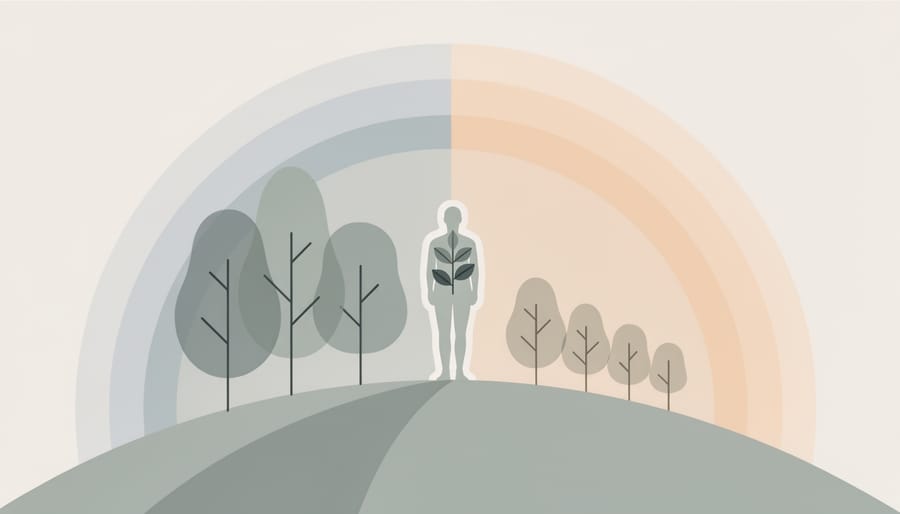
Here’s the truth researchers have discovered: emotional intelligence is genuinely both trait and skill, making the either-or question itself misleading.
Scientists now recognize two distinct models that capture different aspects of EI. Trait emotional intelligence refers to personality-like self-perceptions about your emotional abilities. It measures how you see yourself emotionally, whether you think you’re good at reading others, managing stress, or staying positive. This version behaves like a personality trait: relatively stable over time, linked to temperament, and assessed through self-report questionnaires.
Ability emotional intelligence works differently. It measures actual performance on emotional tasks, much like an IQ test measures cognitive abilities. The Yale EI model for instance, tests whether children can accurately identify emotions in facial expressions, understand how feelings evolve, and solve emotion-based problems. These are teachable, improvable skills.
Research shows these two types don’t always align. A child might score high on trait EI (they believe they’re emotionally skilled) but test lower on ability EI tasks (their actual performance reveals room for growth). Conversely, some children accurately perceive and manage emotions but lack confidence in their emotional capabilities.
Dr. Marc Brackett’s work at Yale demonstrates that while children arrive with different emotional starting points shaped by temperament and genetics, targeted instruction improves their actual emotional skills regardless of those baselines. The mixed nature matters because it means parents face a dual opportunity: accept your child’s natural emotional tendencies while actively building their emotional competencies.
This matters deeply in personalized educational settings, where understanding both dimensions helps teachers support each child effectively. Your daughter might be naturally sensitive (trait) while still learning to name her feelings accurately (ability). Both aspects deserve attention and support.
Different Forms of Emotional Intelligence
Researchers recognize two distinct forms of emotional intelligence, each revealing different aspects of how children understand and manage emotions.
Trait emotional intelligence reflects your child’s self-perceptions about their emotional abilities. When your daughter describes herself as “good at knowing when friends are upset” or your son says he “always stays calm,” they’re expressing trait EI. This form operates like a personality characteristic, relatively stable self-beliefs about emotional competencies that shape how children see themselves and approach emotional situations. Trait EI gets measured through questionnaires asking kids to rate their own emotional tendencies and capabilities.
Ability emotional intelligence, by contrast, represents actual performance on emotion-related tasks. This form captures what your child can genuinely do when asked to identify emotions in facial expressions, predict how someone might feel in a scenario, or generate strategies for managing frustration. Unlike self-perception, ability EI gets assessed through performance tests with right and wrong answers, similar to intelligence tests.
Both forms matter because they tell different stories about your child’s emotional world. A child might have high trait EI (believing they’re emotionally skilled and feeling confident in social situations) but lower ability EI (actually struggling to read subtle emotional cues). Another child might possess strong ability EI (accurately perceiving and understanding emotions) yet low trait EI (feeling uncertain about their emotional competence).
Mixed models combine these approaches, recognizing that emotional intelligence includes both measurable skills and personality-like qualities. Some frameworks add motivational factors, your child’s drive to use emotional information, and behavioral tendencies like empathy and adaptability.
Educational settings increasingly acknowledge that supporting children’s emotional growth means addressing both what they can do and how they perceive their emotional selves.
Why This Matters for Your Child’s Learning
Understanding whether emotional intelligence functions as a trait or skill changes how you support your child at school and home. When teachers recognize that some children naturally notice emotional cues while others need explicit instruction, they can adapt their approach accordingly. Your child might have a calm temperament that makes emotional regulation easier, or they might be naturally intense and require more practice with specific calming techniques.
Modern classrooms increasingly use emotional intelligence assessments to create truly individualized learning plans. A teacher might notice that your highly empathetic daughter becomes overwhelmed during group conflicts, while your son processes emotions internally and needs prompting to identify feelings. These aren’t deficits to fix, they’re starting points that inform how each child learns best. Personalized learning tech can track emotional responses to different teaching methods, helping educators understand when a child needs more emotional scaffolding versus when they’re ready for independence.
This dual understanding prevents two common mistakes. First, it stops us from dismissing a child’s emotional struggles as “just their personality” when they actually need skill-building support. Second, it prevents pushing children to be someone they’re not, expecting a naturally reserved child to become emotionally expressive or vice versa. Instead, you work with their tendencies while expanding their capabilities.
The practical impact shows up daily. If your child has strong trait EI, they might excel in collaborative projects but need help setting emotional boundaries. If they’re still developing these abilities, they benefit from structured emotion vocabulary lessons and clear strategies for handling frustration, which become automatic with practice.
Supporting Your Child’s Emotional Growth
You can support your child’s emotional development in ways that honor both their natural temperament and their capacity to learn. Start by creating an environment where emotions are welcomed rather than dismissed. When your child expresses frustration, sadness, or even joy intensely, resist the urge to immediately fix or minimize the feeling. Instead, name it with them: “You’re really disappointed that playtime ended” or “That made you so excited you can’t sit still.” This simple practice builds emotional vocabulary and validates their internal experience.
Teaching specific emotional skills works best when woven into daily moments rather than formal lessons. Model your own emotional regulation out loud: “I’m feeling frustrated that dinner burned, so I’m going to take three deep breaths before I decide what to do next.” Children absorb these patterns through repetition and example. Practice reading facial expressions together during screen time, asking “How do you think that character feels right now?” These small touchpoints accumulate into genuine competence over time.
Here are practical strategies you can use at home to develop emotional intelligence while respecting your child’s unique nature:
- Create a feelings check-in routine at dinner or bedtime where everyone shares one emotion from their day
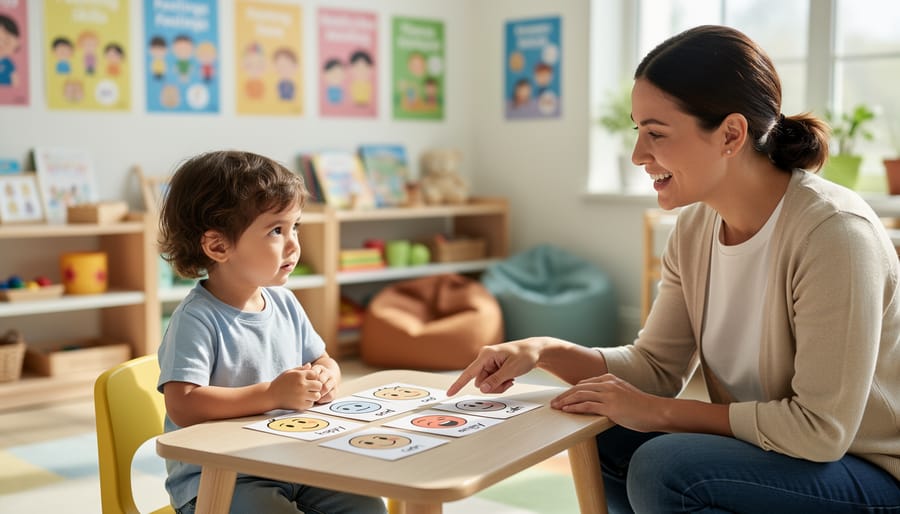
- Use emotion cards or charts to help younger children identify and name what they’re experiencing
- Teach calming techniques like belly breathing, counting backwards, or using a calm-down corner without making it feel like punishment
- Read books together that explore complex emotions and discuss the characters’ choices and feelings
- Practice problem-solving emotional conflicts through role-play with stuffed animals or action figures
- Celebrate effort in managing emotions, not just successful outcomes
Work with your child’s temperament rather than against it. A naturally reserved child doesn’t need to become outgoing, but they can learn to recognize when they need quiet time and communicate that need clearly. A highly sensitive child can develop strategies to manage overwhelming input without changing their fundamental nature.
Partner with your child’s teachers to ensure inclusive emotional support extends across home and school settings. Share what works at home and ask what they’re observing in different contexts. Personalized learning environments often include social-emotional learning components, and you can reinforce those same concepts through consistent language and approaches.
One mother shared how she struggled when her eight-year-old son’s teacher described him as emotionally immature compared to peers. She felt caught between accepting his slower emotional development as part of who he was and worrying she should be doing more. Working with a school counselor, she realized both were true: her son did process emotions differently than many classmates, and he could still learn better strategies at his own pace. They created a simple emotion thermometer he used both at school and home, rating his feelings from one to five and choosing matching coping tools. Within months, he was initiating conversations about his emotions rather than shutting down, a shift that came from meeting him exactly where he was.
Common Questions About Emotional Intelligence and Personality
Can emotional intelligence change over time?
Yes, emotional intelligence can definitely improve with practice and guidance, especially during childhood when the brain is still developing. While some children naturally pick up emotional skills more easily than others, all kids can strengthen their ability to recognize, understand, and manage emotions through consistent support and teaching.
Is my child’s emotional sensitivity just their personality?
Your child’s baseline sensitivity to emotions does reflect their temperament, which is fairly stable. However, what they do with that sensitivity, how they interpret, express, and regulate those feelings, involves skills you can help them develop, making this a case where both nature and nurture play important roles.
How do I know if my child needs help with emotional skills versus just accepting their temperament?
If your child’s emotional responses interfere with friendships, learning, or daily functioning, or if they seem distressed by their inability to manage feelings, those are signs that skill-building support would help. Accepting temperament means honoring whether your child is naturally reserved or expressive, while still teaching them healthy ways to handle whatever emotions they experience.
What role does genetics play in emotional intelligence?
Research suggests genetics influences aspects of emotional intelligence, particularly traits like emotional sensitivity and initial temperament. But genes don’t determine destiny, environment, relationships, and learning experiences shape how these tendencies develop into actual emotional capabilities.
These questions reflect the concerns many parents bring to their child’s teachers or pediatricians. You might wonder when a personality quirk crosses into something requiring intervention. Trust your instincts here. If your typically cheerful child suddenly struggles to bounce back from disappointments, or your sensitive child can’t make it through a school day without melting down, those changes warrant attention.
Watch for patterns rather than isolated incidents. All children have bad days, rough weeks, or developmental phases where emotions run high. Concern arises when emotional difficulties persist across different settings, interfere with your child’s ability to learn or connect with others, or cause them significant distress. A six-year-old who occasionally hits when frustrated is learning. A six-year-old who consistently can’t calm down enough to participate in class activities might benefit from targeted support.
The beautiful truth is that personalized learning environments can accommodate both aspects. Teachers can respect your child’s natural emotional temperament while simultaneously teaching specific skills that help them thrive. You don’t have to choose between accepting who your child is and helping them grow, you can do both.
So is emotional intelligence a personality trait? The honest answer is both yes and no. Your child’s emotional intelligence reflects tendencies they were born with and capabilities they can develop with your support. Some children naturally tune into emotions more easily, while others need more guidance. That’s perfectly normal.
What matters most is knowing you can help your child strengthen their emotional skills regardless of where they start. The shy kindergartner can learn to express needs confidently. The impulsive third-grader can develop better self-control. The teenager who struggles to read social cues can practice these skills until they become second nature.
This matters deeply in educational settings that recognize each child’s unique emotional profile. Personalized learning approaches honor your child’s natural temperament while building the specific skills they need to thrive. You don’t have to choose between accepting who your child is and helping them grow. You do both.
Start where your child is today. Notice their emotional strengths and struggles without judgment. Teach one skill at a time. Model the emotional awareness you want to see. Partner with teachers who understand that emotional growth happens differently for every child.
Your child’s emotional journey is uniquely theirs, and you’re the perfect guide for it.